
DONKEY KONG ARCADE GAME RENTAL
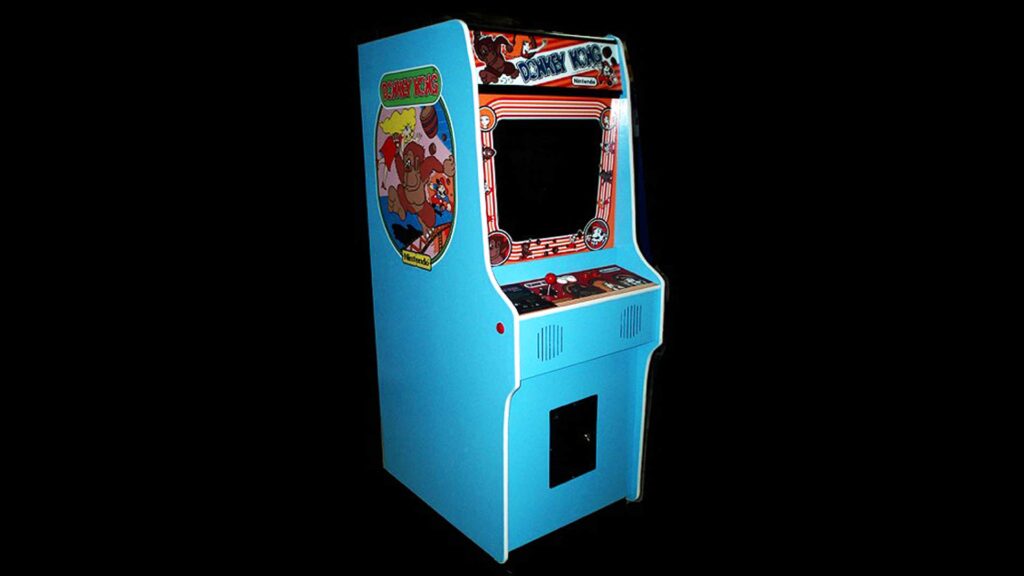
Planning an event with arcade games?
Here’s your chance to rent an old classic, a real Donkey Kong arcade machine game for your next party or event in Florida.
Whether it’s a birthday party, corporate event, or a tradeshow, you can rent your favorite retro arcade machine for your upcoming social function. Rent your favorite retro 1980’s (eighties) classic arcade game rental for your next event in Florida.
Donkey Kong is a video game series and media franchise created by the Japanese game designer Shigeru Miyamoto for Nintendo. It follows the adventures of Donkey Kong, a large, powerful gorilla, and other members of the Kong family of apes. Donkey Kong games include the original arcade game trilogy by Nintendo R&D1; the Donkey Kong Country series by Rare and Retro Studios; and the Mario vs. Donkey Kong series by Nintendo Software Technology. Various studios have developed spin-offs in genres such as edutainment, puzzle, racing, and rhythm. The franchise also incorporates animation, printed media, theme parks, and merchandise.
Miyamoto designed the original 1981 Donkey Kong to repurpose unsold arcade cabinets following the failure of Radar Scope (1980). It was a major success and was followed by the sequels Donkey Kong Jr. (1982) and Donkey Kong 3 (1983). Nintendo placed the franchise on a hiatus as it shifted focus to the spin-off Mario franchise. Rare’s 1994 reboot, the Super Nintendo Entertainment System (SNES) game Donkey Kong Country, reestablished Donkey Kong as a major Nintendo franchise. Rare developed Donkey Kong games for the SNES, Game Boy, and Nintendo 64 until it was acquired by Microsoft in 2002; subsequent games were developed by Nintendo, Retro Studios, Namco and Paon. After Donkey Kong Country: Tropical Freeze (2014), the franchise went on another hiatus, which ended with Donkey Kong Bananza (2025).
The main Donkey Kong games are platformers in which the player must reach the end of a level. Donkey Kong appears as the antagonist or protagonist; his role alternates between games. The original games featured a small cast of characters, including Donkey Kong, Mario, and Pauline. Rare’s games expanded the cast with friendly Kongs alongside the Kremlings, an army of antagonistic crocodiles led by Donkey Kong’s nemesis King K. Rool. Mario, the protagonist of the 1981 game, became Nintendo’s mascot and the star of the Mario franchise, and Donkey Kong characters appear in Mario games such as Mario Kart, Mario Party, and Mario Tennis. Donkey Kong characters also feature in crossover games such as Mario & Sonic and Super Smash Bros.
Outside of video games, the franchise includes the animated series Donkey Kong Country (1997–2000), a themed area in Super Nintendo World at Universal’s theme parks, soundtrack albums, and Lego construction toys. Donkey Kong is one of Nintendo’s bestselling franchises, with more than 65 million copies sold by 2021. The original game was Nintendo’s first major international success; it rescued Nintendo of America from a financial crisis, and established it as a prominent force in the video game industry. The franchise has pioneered or popularized concepts such as in-game storytelling and pre-rendered graphics, inspired other games (including clones), and influenced popular culture.
DONKEY KONG GAME PLAY
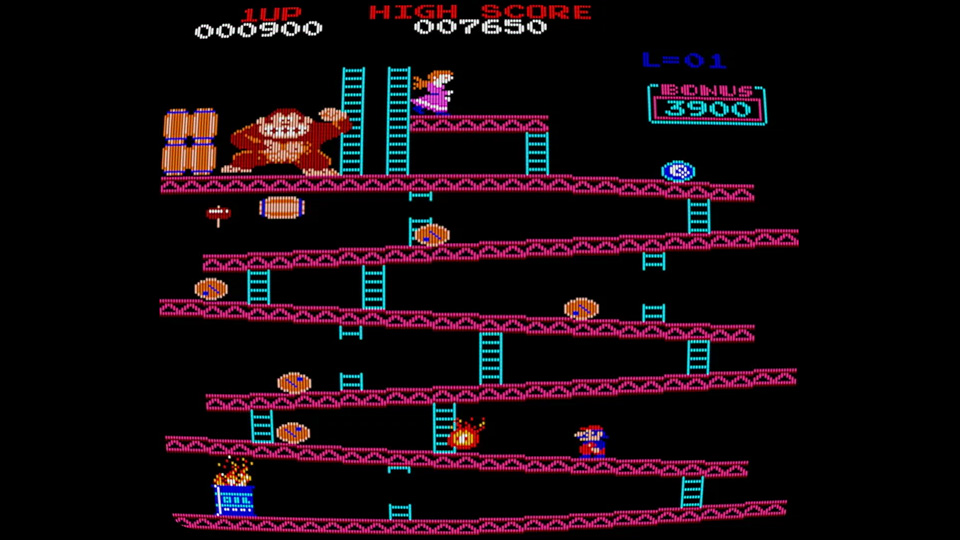
Donkey Kong and Donkey Kong Jr. are early examples of the platform game genre. In both games, the player must guide the playable character (Mario in the first game, Donkey Kong Jr. in the second) to scale four levels while avoiding obstacles. The player jumps to dodge incoming obstacles (such as barrels) or cross gaps and climbs ladders or vines to reach the top of the level. In the first game, Mario can destroy obstacles by obtaining a hammer power-up, while in the second, Donkey Kong Jr. can do so by knocking pieces of fruit down from vines. Points are awarded for dodging or destroying obstacles, collecting items, and completing stages quickly. The player begins each game with three lives, which they lose if they touch an obstacle or fall.
Donkey Kong 3 departs from this gameplay: it is a shooter game in which the player controls Stanley, an exterminator who must prevent Donkey Kong from stirring up insects in his greenhouse. The player fires bug spray at Donkey Kong and enemy insects that attempt to steal Stanley’s flowers. They complete levels by spraying Donkey Kong enough to force him to the top of the screen or by killing all the insects.
The 1994 Game Boy game begins with the four stages from the original Donkey Kong, but after completing the fourth, the player is presented with over 100 additional stages that introduce puzzle-platform gameplay in which Mario must scout each level within a time limit to locate a key. Mario can pick up and throw objects and enemies, similar to Super Mario Bros. 2, and perform acrobatics to reach otherwise inaccessible areas of the levels. This gameplay would serve as the basis for Mario vs. Donkey Kong, which introduces stages in which Mario must guide six Mini-Mario toys to a toy box while protecting them from hazards. Mario vs. Donkey Kong‘s sequels make guiding the Mini-Mario toys the focus, with each stage requiring the player to do so with touchscreen controls.[
Donkey Kong Game Release
In the late 1970s, the Japanese company Nintendo shifted its focus from producing toys and playing cards to arcade games. This followed the 1973 oil crisis, which increased the cost of manufacturing toys, and the success of Taito‘s arcade game Space Invaders (1978). In 1980, Nintendo released Radar Scope, a Space Invaders-style shoot ’em up.[1] It was a commercial failure and put the newly established subsidiary Nintendo of America in a financial crisis. Its founder, Minoru Arakawa, asked his father in-law, Nintendo CEO Hiroshi Yamauchi, to provide a new game that could repurpose the unsold Radar Scope cabinets.[2] Most of Nintendo’s top developers were preoccupied, so the task went to Shigeru Miyamoto, a first-time game designer.[3][4]
Supervised by Gunpei Yokoi,[3] Miyamoto settled on a love triangle with the characters Bluto, Popeye, and Olive Oyl from the Popeye franchise, but a licensing deal between Nintendo and King Features fell through.[4][b] Bluto evolved into a gorilla, an animal Miyamoto said was “nothing too evil or repulsive”.[5] He was named Donkey Kong—donkey to convey stubborn and kong to imply gorilla.[8] Popeye became Mario, the new protagonist, while Olive Oyl became Pauline, the damsel in distress.[4] Miyamoto cited the fairy tale “Beauty and the Beast” and the 1933 film King Kong as influences.[5]
Donkey Kong was one of the earliest platform games,[c] with players controlling Mario as he ascends a construction site to rescue Pauline from Donkey Kong.[10] Whereas previous platform games focused on climbing,[9] Miyamoto placed an emphasis on jumping to avoid obstacles and cross gaps. He envisioned something akin to a playable comic strip that unfolded across multiple levels with unique scenarios. This was uncommon in contemporary arcade games, which typically featured a single scenario that repeated.[11] As he lacked programming expertise, Miyamoto consulted technicians on whether his ideas were possible.[12] Four programmers from Ikegami Tsushinki spent three months turning Miyamoto’s design into a finished game.[13]
Although Miyamoto’s team was told it would be a failure,[14] Donkey Kong became Nintendo’s first major international success upon its release in July 1981. The $280 million windfall gain rescued Nintendo of America from its financial crisis and established it as a prominent brand in America.[15][16] Donkey Kong achieved further success in 1982, when Nintendo released a Game & Watch adaptation and licensed it to Coleco for ports to home consoles.[17][18] It grossed $4.4 billion across various platforms, making it one of the highest-grossing games of all time.[19] In 1982, Universal City Studios filed a lawsuit alleging Donkey Kong violated its trademark of King Kong. The lawsuit failed when Nintendo’s lawyer, Howard Lincoln, discovered that Universal had won a lawsuit in 1976 by declaring that King Kong was actually in the public domain.[20][21]
1982–1994: Sequels and First Hiatus
Miyamoto and his team used game mechanics and levels that could not be included in Donkey Kong as the basis for a sequel. Miyamoto wanted to make Donkey Kong the protagonist, but the sprite graphic was too big to easily maneuver, so he created a new character, Donkey Kong Jr. The team still wanted Donkey Kong on top of the screen, so they conceived a plot in which Mario had caged him and Donkey Kong Jr. had to save him. To develop Donkey Kong Jr. (1982), Nintendo reverse-engineered Ikegami’s Donkey Kong code, making it the first game that Nintendo developed without outside help. Following Donkey Kong Jr.‘s release, Ikegami sued Nintendo for copyright infringement. In 1990, the Tokyo High Court ruled in favor of Ikegami, and the companies reached a settlement.
Donkey Kong 3, released in 1983, features shooter gameplay that departs from its predecessors. Instead of Mario, the player controls Stanley, an exterminator from the Game & Watch game Green House (1982), who must fend off Donkey Kong and a swarm of bees. Donkey Kong 3 was unsuccessful, as was Donkey Kong Jr. Math (1983), an edutainment game for the Nintendo Entertainment System (NES). Sega obtained the license to develop a game featuring a playable Donkey Kong as a parking attendant, but it was canceled after Sega’s David Rosen and Hayao Nakayama arranged a management buyout from Gulf and Western Industries in 1984.
The franchise went on an extended hiatus, while the spin-off Mario franchise found success on the NES, cementing Mario as Nintendo’s mascot Donkey Kong’s appearances in the years following Donkey Kong 3 were limited to cameos in unrelated games. Nintendo staff began discussing a Donkey Kong revival as the original game’s tenth anniversary approached in 1991. They were unable to start a new game at the time, so they included Donkey Kong Jr. as a playable character in Super Mario Kart (1992). However, the discussions led to the production of the Game Boy game Donkey Kong (1994), the first original Donkey Kong game in ten years. It features Mario as the player character and begins as a remake of the 1981 game before introducing over 100 puzzle-platforming levels that incorporate elements from Donkey Kong Jr. and Super Mario Bros. 2 (1988).
The 1987 Official Nintendo Player’s Guide advertised a Donkey Kong revival for the NES, Return of Donkey Kong, which was never released. In the early 1990s, Philips obtained the license to use five Nintendo characters, including Donkey Kong, in games for the CD-i format. Philips contracted Riedel Software Productions to make a CD-i Donkey Kong game; it was developed between 1992 and 1993, but canceled. The 2020 Nintendo data leak included a prototype for Super Mario World 2: Yoshi’s Island (1995) featuring a protagonist who resembles Stanley. Its title, Super Donkey, suggested that Yoshi’s Island began as a Donkey Kong game before it was altered to star the Mario character Yoshi.
*Some of the content information above was provided by Wikipedia and KLOV (Killer List of Video Games).
*Visit our main website https://cocktailhourentertainment.com
For More Information fill out our Contact Form
WHY RENT YOUR FAVORITE CLASSIC ARCADE GAME FROM US?
If you’re planning an event in Florida we’re your one-stop-shop for “extra” entertainment.
PACKAGE DISCOUNTS
Rent 3 or more classic arcade games and get a special discount.
BIGGEST SELECTION
Florida’s largest selection of classic arcade games for rent.
COMPETITIVE PRICING
The best pricing in Florida for classic arcade game rentals.
REAL ARCADE MACHINES
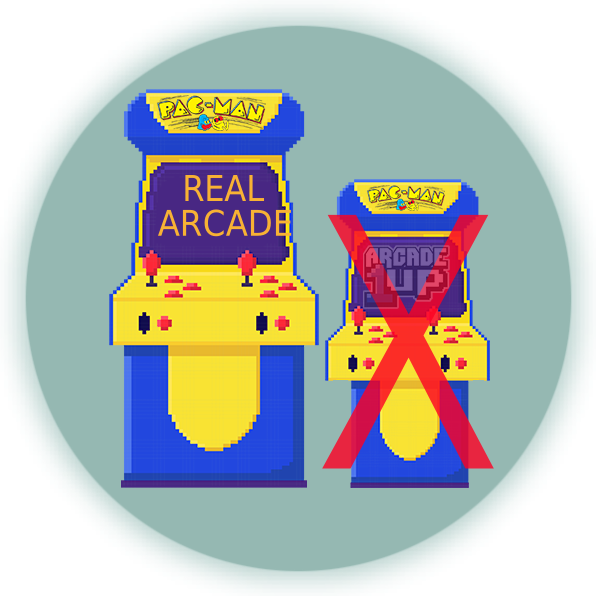
We rent real arcade machines, not Arcade1Up toys from walmart.
WE ARE A FLORIDA BASED RENTAL COMPANY
Always hire a local game rental company, not a game rental company located out of state! Why? The further a company has to travel the more likely something could go wrong. Most out of state game rental companies work from a rolodex. They put adds in every state and make a nice website creating the illusion they are local, but they’re based in another state such as New York or New Jersey. This is why their price is higher. Did you know they usually subcontract a local company like us because it’s easier and cheaper for them. We love being trusted to do this and we will only give out their business cards so you’d never know. Hire us directly for less!

Smart Recommendations
Trust the company hired by the Ritz Carlton, Four Season, The Breakers, Miami Heat, Orlando Magic, and so many others for their corporate events.
- Party Planners trust us for their game rental needs.
- Local and out of state DMCs trust us as a reliable source for game rentals.
- DJ companies, Bands, Caterers, Decorators, and even our competitors call us!
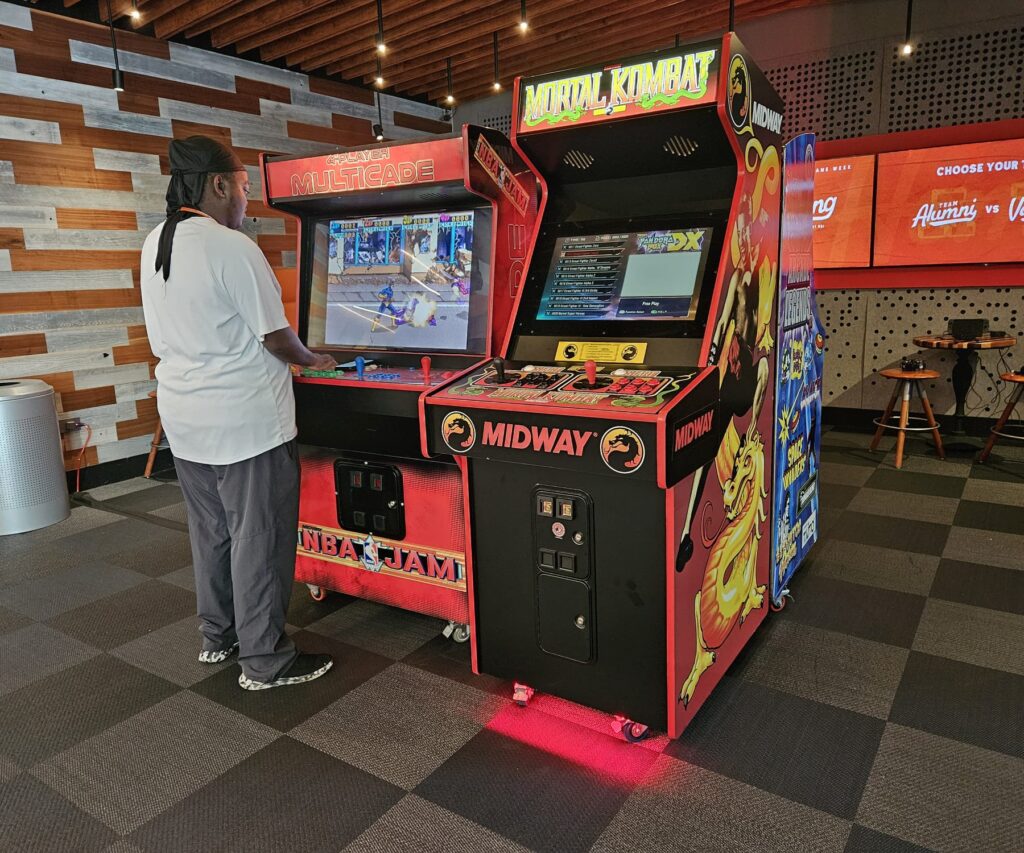
“Rent your DONKEY KONG classic arcade machine now!"
“Rent your DONKEY KONG classic arcade machine now!"
A few of our customers: