
DEFENDER ARCADE GAME RENTAL
Planning an event with arcade games?
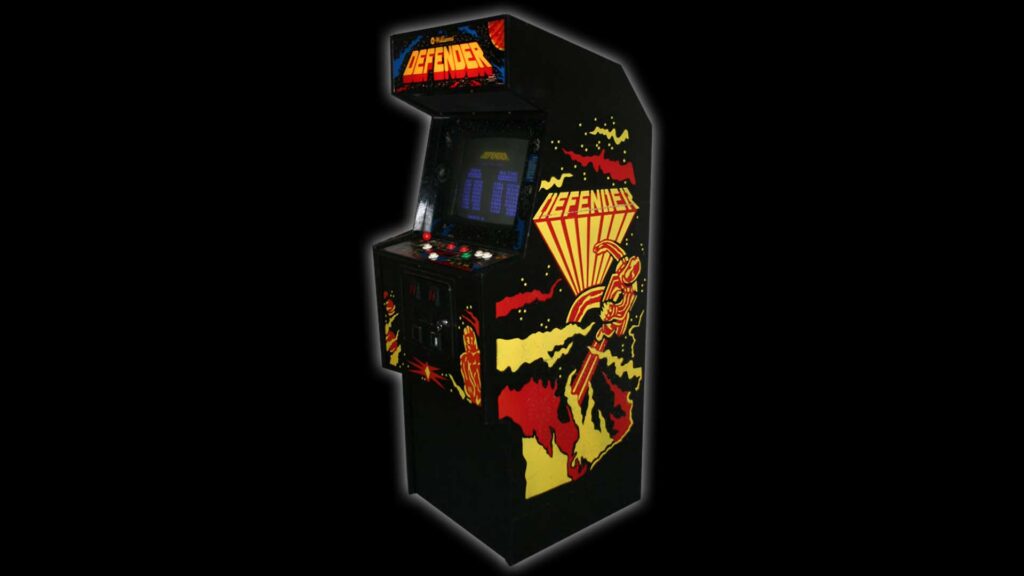
Here’s your chance to rent an old classic, a real Defender arcade machine game for your next party or event in Florida.
Whether it’s a birthday party, corporate event, or a tradeshow, you can rent your favorite retro arcade machine for your upcoming social function. Rent your favorite retro 1980’s (eighties) classic arcade game rental for your next event in Florida.
Defender is a 1981 horizontally scrolling shooter video game developed by Williams Electronics for arcades. The game is set on either an unnamed planet or city (depending on platform) where the player must defeat waves of invading aliens while protecting astronauts. Development was led by Eugene Jarvis, a pinball programmer at Williams; Defender was Jarvis’s first video game project and drew inspiration from Space Invaders and Asteroids. Defender was demonstrated in late 1980 and was released in March 1981. It was distributed in Japan by Taito.
Defender was one of the most important titles of the golden age of arcade video games, selling over 55,000 units to become the company’s best-selling game and one of the highest-grossing arcade games ever. Praise among critics focused on the game’s audio-visuals and gameplay. It is frequently listed as one of Jarvis’s best contributions to the video game industry and one of the most difficult video games. Though not the first game to scroll horizontally, it created the genre of horizontal scrolling shoot ’em ups. It inspired the development of other games and was followed by sequels and many imitations.
Ports were developed for contemporary game systems, most of them by either Atari, Inc. or its software label for non-Atari platforms, Atarisoft. The 1982 Atari 2600 version was one of the best-selling games for the system and sold over 3 million cartridges.
DEFENDER GAME PLAY
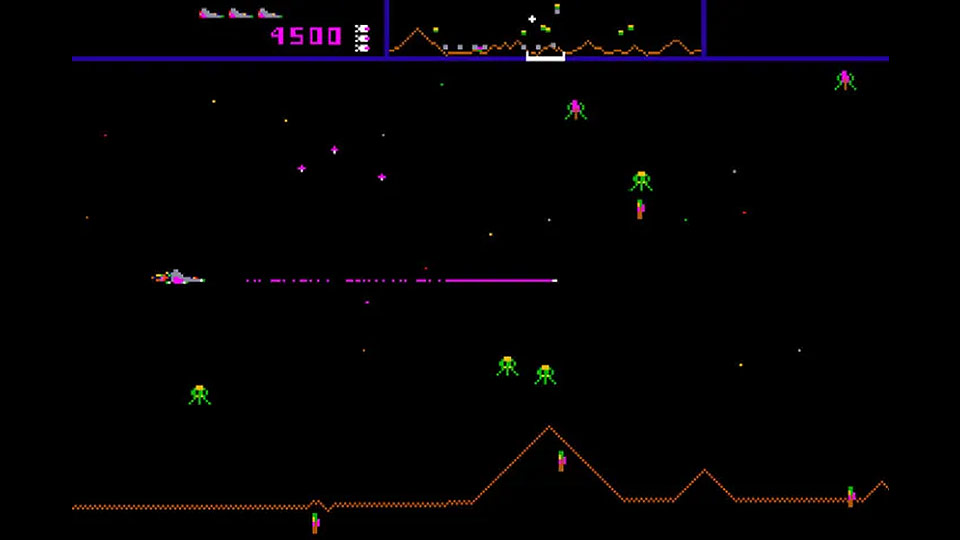
Defender is a side-view, horizontally scrolling shooter set on the surface of an unnamed planet. The player controls a spaceship flying either to the left or right. A joystick controls the ship’s elevation, and five buttons control its horizontal direction and weapons. The player starts with three “smart bombs”, which destroy all visible enemies. As a last resort, the “hyperspace” button works as in Asteroids: the player’s ship reappears in a random—possibly unsafe—location. Players are allotted three ships at the start of the game; another ship and smart bomb are awarded every 10,000 points (adjustable per machine). Two players can alternate turns.
The object is to destroy all alien invaders, while protecting astronauts on the landscape from abduction. Landers pick up humans and attempt to carry them to the top of the screen at which point they turn into fast-moving mutants. A captured human can be freed by shooting the lander, then catching the human before it falls to its death, and dropping it off on the ground.
Defeating the aliens allows the player to progress to the next level. Failing to protect the astronauts, however, causes the planet to explode and the level to become populated with mutants. Surviving the waves of mutants results in the restoration of the planet. A ship is lost if it is hit by an enemy or its projectiles, or if a hyperspace jump goes wrong (as they randomly do). After exhausting all ships, the game ends.
DEFENDER Game Release
The game was slow to gain popularity, not attracting much attention at the 1980 AMOA show. In retrospect, Jarvis believed many passersby were intimidated by its complexity. The game was well received in arcades, and crowds gathered around the cabinet during its first nights of play testing. The success spurred Williams to release a cocktail version as well. Defender eventually became Williams’ best-selling arcade game, with over 55,000 units sold worldwide, and it became one of the highest grossing arcade games ever, earning over US $1 billion. It has sold 70,000 arcade units as of 2020, and grossed over $1.5 billion worldwide as of 2000. In Japan, Defender was not as highly successful: it tied with Turbo and Galaxian as Japan’s 18th highest-grossing arcade video game of 1981.
Six months after its release, the game was one of the top earners in the United States video game industry. On the 1981 arcade game charts, it topped the Play Meter arcade chart in August, and the RePlay arcade charts for most months between April and November. The annual Cash Box and RePlay arcade charts listed Defender as the second highest-grossing arcade game of 1981 in the US, just below Pac-Man. The Amusement & Music Operators Association (AMOA) later listed Defender among America’s six highest-grossing arcade games of 1982.
Co-designer Larry Demar was surprised by the game’s popularity. At the time of its release, Stan Jarocki, director of marketing at then-competitor Midway Manufacturing,[Note 1] described the game as “amazing”.
The Atari VCS port sold over 3 million copies, becoming the second best-selling Atari home video game of 1982 (just below the Atari version of Pac-Man). However, at least 68,993 copies of Defender were returned in 1983. Across all home platforms, the game has sold over five million cartridges worldwide as of 2000.
DEFENDER REMAKES & SEQUELS
The success of Defender prompted Williams to approach Vid Kidz, who originally wanted to create a new game. DeMar, however, suggested creating an enhanced version of Defender to meet Williams’ four-month deadline. Vid Kidz titled the game Stargate and developed it as a sequel to Defender. It features new elements and improved the original’s performance. Some home ports of Stargate were released under the title Defender II. Williams released a Defender-themed pinball machine in 1982. It has many elements from the original game: sound effects, enemies, waves, and weapons. Williams produced fewer than 400 units.
Midway’s 1991 Strike Force is an update and indirect sequel to Defender. Jarvis and DeMar assisted with the game. Atari Corporation released Defender 2000 in 1995 for the Atari Jaguar. It was developed by Jeff Minter, who had previously updated Tempest as Tempest 2000. A 2002 remake, published simply as Defender, uses 3D graphics and a third-person viewpoint. It was released for the Xbox, GameCube, and PlayStation 2. The original game is included in the 1996 compilation Williams Arcade’s Greatest Hits and the 2003 compilation Midway Arcade Treasures. In 1997, Tiger Electronics released a handheld edition of Defender with a grayscale LCD screen, which doubles as a keychain ornament.
Home games that copied Defender‘s design include Gorgon (1981) and Repton (1983) for the Apple II; Alien Defense (1981) for the TRS 80 Model III; Chopper Command (1982) for the Atari 2600; Protector II (1983) and Dropzone (1984) for the Atari 8-bit computers; and, for the BBC Micro, Defender (1982) was renamed to Planetoid (1984) to avoid litigation. It influenced Jeff Minter‘s Andes Attack for the VIC-20 home computer. StarRay (1988) was retitled Revenge of Defender in the US. Some games, such as The Tail of Beta Lyrae (1983) and R-Type (1987), were influenced more by Defender‘s side-scrolling action than the gameplay itself. Later games influenced by Defender include Datastorm (1989) for the Amiga and Fantasy Zone (1986) for arcades and a variety of home consoles.
Impact and legacy
Players have competed to obtain the highest score at the game and the longest play time on a single credit. Competitive playing for the longest play time was popularized by Mario Suarez from Atlantic City, who played Defender for over 211⁄2 hours in 1982 at the Claridge Casino Hotel in Atlantic City. It was authenticated by the facility and the many witnesses that watched along with the press of Atlantic City; the media attention spurred other players to attempt the same feat. Expert players exploited software bugs to extend the length of their play time. Defender was the focus of the first Twin Galaxies video game contest. Players in 32 cities simultaneously competed on the weekend of April 3–4, 1982. Rick Smith was the victor with a score of 33,013,200 which took 38 hours. One bug, related to how the game keeps track of scoring, allows players to earn a large number of “extra lives”. Players can then use the extra lives to leave the game unattended while they rest. Other bugs allow the ship to avoid damage from the enemies, also prolonging the length of play.
Defender is considered the first side-scrolling shoot ’em up, predating Scramble by two months. Professor Jim Whitehead described Defender as a breakthrough title for its use of full 2D motion, multiple goals, and complex gameplay that provides players with several methods to play. James Hague of Dadgum Games called Defender a landmark title from the 1980s. Stearny said that the game’s use of scrolling helped remove design limitations associated with the screen. Cuciz stated that Defender‘s use of scrolling introduced the “first true ‘gaming environment'”. He further said that though the game’s mini-map feature had been introduced before, Defender integrated it into the gameplay in a more essential manner. Stearny described it as the most important space game in the early 1980s. He commented that its realism and technological advances pushed developers to create more popular games, citing Gorf and Phoenix as examples. Vince listed the game as a classic title that introduced new technology, specifically scrolling. Ellis stated that prior to Defender, companies designed video games to have a balanced challenge. They believed games should be easy enough to attract players but difficult enough to limit play time to a few minutes; anything too challenging would dissuade players. Loguidice and Barton commented that Defender‘s success, along with Robotron: 2084, illustrated that video game enthusiasts were ready for more difficult games, which spurred developers to create more complex game designs.
Jarvis’s contributions to the game’s development are often cited among his accolades. Author John Vince considered him one of the originators of “high-action” and “reflex-based” arcade games, citing Defender‘s gameplay among other games designed by Jarvis. Ellis said that Jarvis established himself as an early “hard-core” designer with Defender. In 2007, IGN listed Eugene Jarvis as a top game designer whose titles (Defender, Robotron: 2084 and Smash TV) have influenced the video game industry. Barton and Loguidice stated that the game helped establish Williams and Jarvis as key figures in the arcade game industry. Sellers echoed similar comments. After the success of Defender, Williams expanded their business by building a new facility and hired more employees. Before the expansion, Jarvis could work in isolation. But the influx of people created an environment he was unhappy with. He left Williams along with DeMar to found their own development company, Vid Kidz. The company served as a consulting firm to Williams and developed two games for them.
*Some of the content information above was provided by Wikipedia and KLOV (Killer List of Video Games).
*Visit our main website https://cocktailhourentertainment.com
For More Information fill out our Contact Form
WHY RENT YOUR FAVORITE CLASSIC ARCADE GAME FROM US?
If you’re planning an event in Florida we’re your one-stop-shop for “extra” entertainment.
PACKAGE DISCOUNTS
Rent 3 or more classic arcade games and get a special discount.
BIGGEST SELECTION
Florida’s largest selection of classic arcade games for rent.
COMPETITIVE PRICING
The best pricing in Florida for classic arcade game rentals.
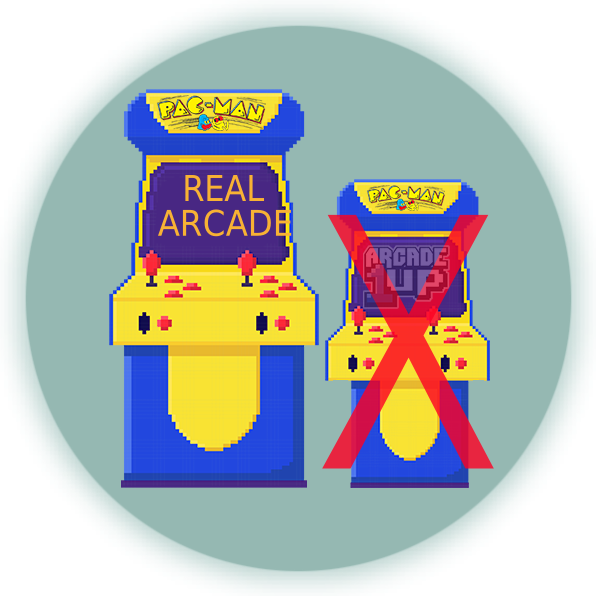
REAL ARCADE MACHINES
We rent real arcade machines, not Arcade1Up toys from walmart.
WE ARE A FLORIDA BASED RENTAL COMPANY
Always hire a local game rental company, not a game rental company located out of state! Why? The further a company has to travel the more likely something could go wrong. Most out of state game rental companies work from a rolodex. They put adds in every state and make a nice website creating the illusion they are local, but they’re based in another state such as New York or New Jersey. This is why their price is higher. Did you know they usually subcontract a local company like us because it’s easier and cheaper for them. We love being trusted to do this and we will only give out their business cards so you’d never know. Hire us directly for less!

Smart Recommendations
Trust the company hired by the Ritz Carlton, Four Season, The Breakers, Miami Heat, Orlando Magic, and so many others for their corporate events.
- Party Planners trust us for their game rental needs.
- Local and out of state DMCs trust us as a reliable source for game rentals.
- DJ companies, Bands, Caterers, Decorators, and even our competitors call us!
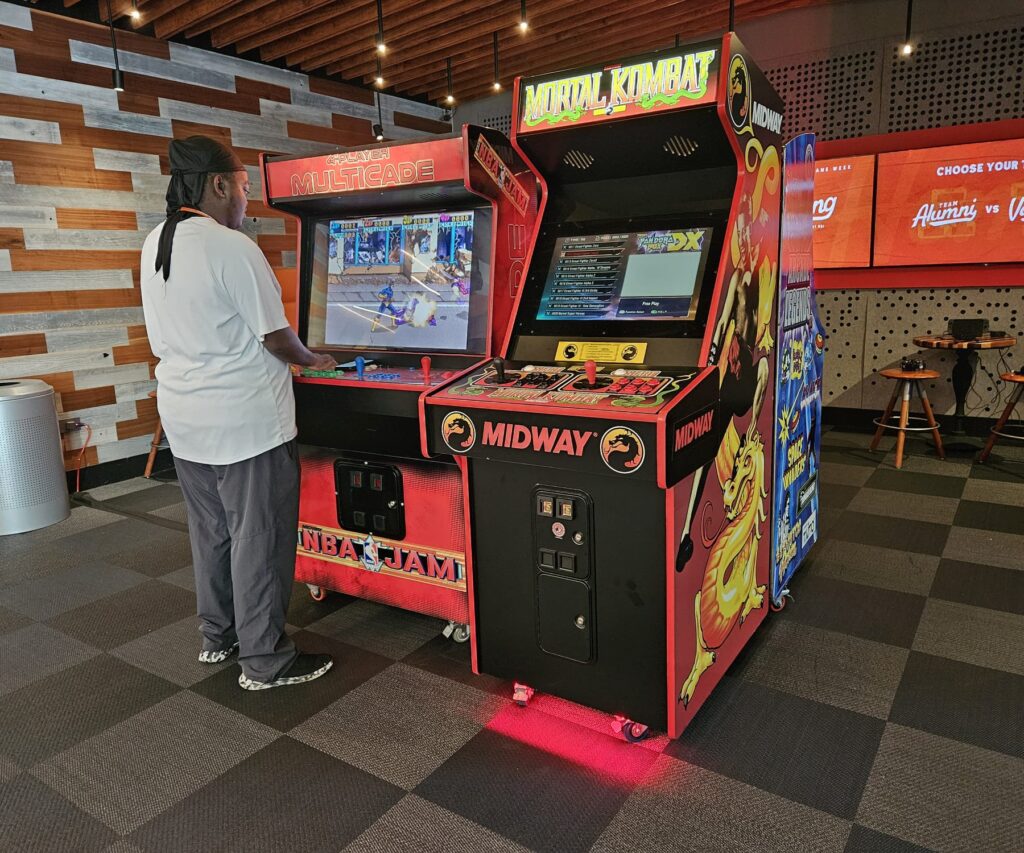

“Rent your DEFENDER classic arcade machine now!"
“Rent your DEFENDER classic arcade machine now!"
A few of our customers: