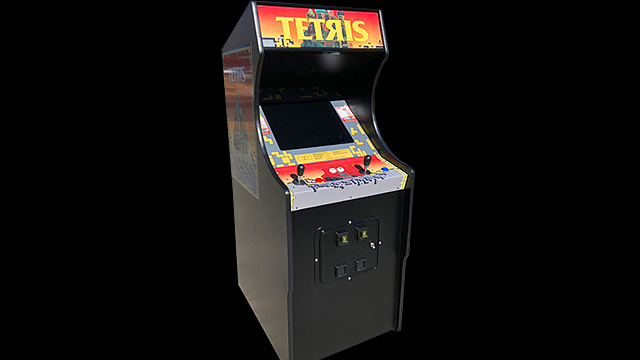
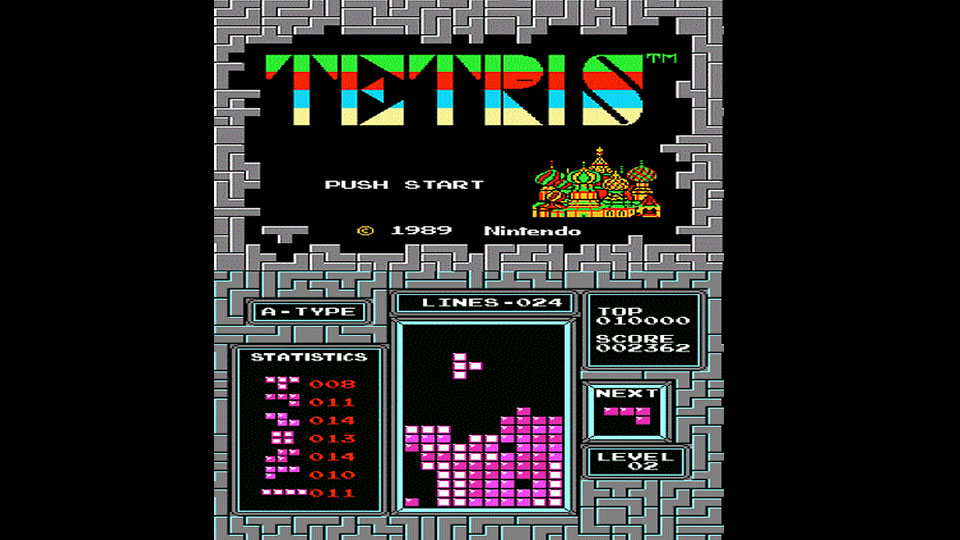
TETRIS GAME PLAY
Tetris is a puzzle video game with a consistent general design across its numerous versions. Gameplay consists of a rectangular field in which tetromino pieces, geometric shapes consisting of four connected squares, descend from the top-center. During the descent, the player can move the piece horizontally and rotate them until they touch the bottom of the field or another piece. The player’s goal is to stack the pieces in the field to create horizontal lines of blocks. When a line is completed, it disappears, and the blocks placed above fall one row. As lines are cleared, the speed of the descending pieces increase. The game ends if the accumulated pieces in the field block other pieces from entering the field, a process known as “topping out”. Common mechanics among Tetris variants include soft drop (the ability to increase the descent of the piece), hard drop (instantly placing the piece as far down as it can go), and holding (reserving a piece for later use).
The objective of Tetris is to collect as many points as possible during a gameplay session by clearing lines. Tetris‘s scoring system has remained mostly consistent since Tetris DS (2006) with some exceptions. Points gained during gameplay increase with the descent speed. The more lines cleared at once, the higher the score for a line clear; clearing four lines at once using an I-piece is referred to as a “Tetris”. The player can also gain points by using hard drops or soft drops. There are advanced techniques that can gain more points than a Tetris, including T-spins (spinning a T-piece into a blocked gap), perfect clears (emptying the field following a line clear), and combos (clearing lines with multiple pieces in a row).
Creation (1984–1985)
.jpg)
Alexey Pajitnov was a speech recognition and artificial intelligence researcher for the Dorodnitsyn Computing Center of the Academy of Sciences. Pajitnov developed several puzzle games on the institute’s Elektronika 60, an archaic Russian clone of the PDP-11 computer. In June 1984, he became inspired to convert pentomino tiling puzzles to the computer after he bought a pentomino puzzle set from a store and played with it in his office. Pajitnov wrote Tetris using Pascal for the RT-11 operating system on the Elektronika 60 and experimented with different versions. Because the Elektronika 60 had no graphical interface, Pajitnov modeled the field and pieces using spaces and brackets. He felt that the game would be needlessly complicated with the twelve different shape variations of pentominoes, so he scaled the concept down to tetrominoes, of which there are seven variants. Afterward, he programmed the basic mechanics, including the ability to flip tetrominoes as they fell in a vertical screen and the clearing of lines. The name Tetris was a combination of “tetra” (meaning “four”) and Pajitnov’s favorite sport, tennis. Pajitnov completed the first version of Tetris c. 1985. This version had no scoring system and no levels, but it nonetheless captivated Pajitnov’s peers.
Pajitnov sought to port Tetris to the IBM Personal Computer (IBM PC), which had a higher-quality display than the Elektronika 60. He recruited his colleague Dmitry Pavlovsky and the 16-year-old computer prodigy Vadim Gerasimov. Using Turbo Pascal, the three adapted Tetris to the IBM PC over two months, with Gerasimov incorporating color and Pavlovsky incorporating a scoreboard. Floppy disk copies of this version were distributed freely throughout the Dorodnitsyn Computing Center, before spreading quickly among Moscow computer circles. Pajitnov kept note of second-hand accounts of Tetris‘s spread during this time. Tetris reportedly won second place in a Zelenodolsk computer game competition in November 1985, and by 1986, nearly everyone with an IBM computer in Moscow and similar cities had played Tetris.
Spread beyond the Soviet Union (1985–1988)


.png)
Under Soviet law, intellectual rights were not protected, and the state-run organization Elektronorgtechnica (Elorg) had a monopoly on the import and export of software. To compensate for his lack of knowledge of the business world, Pajitnov asked his supervisor, Victor Brjabrin, who knew more of the world outside the Soviet Union, to help him publish Tetris. Pajitnov offered to transfer the rights to the Academy and was delighted to receive a non-compulsory remuneration from Brjabrin through this deal. In 1986, Brjabrin sent a copy of Tetris to the Hungarian game publisher Novotrade, and copies began circulating via floppy disks throughout Hungary. Robert Stein, an international software salesman for the London-based firm Andromeda Software, saw the commercial potential during a visit to Hungary in June 1986. After an indifferent response from the Academy, Stein contacted Pajitnov and Brjabrin by fax to obtain the license rights. The Soviet researchers expressed interest in forming an agreement with Stein via fax, but were unaware that this fax communication could be considered a legal contract in the Western world; Stein began to approach other companies to produce the game.
Stein approached publishers at the 1987 Consumer Electronics Show in Las Vegas, and signed two agreements: he sold the European rights to the publisher Mirrorsoft and the American rights to its sister company, Spectrum HoloByte. Spectrum HoloByte obtained the rights after a visit to Mirrorsoft by the Spectrum HoloByte president, Phil Adam, when he played Tetris for two hours. At that time, Stein had not yet signed a contract with the Soviet Union. Nevertheless, he sold the rights to the two companies for £3,000 and royalties of 7.5–15% of sales. Before releasing Tetris in the United States, the Spectrum HoloByte CEO, Gilman Louie, asked for an overhaul of the graphics and music. The Soviet spirit was preserved, with fields illustrating Russian parks and buildings as well as melodies anchored in Russian folklore of the time. The company’s goal was to make people want to buy a Russian product. The game came complete with a red package and Cyrillic text, an unusual approach in the West.
Tetris was first commercially released in the West on the IBM PC, with other computer systems planned for release in the following weeks. The Mirrorsoft version was released in Europe on January 27, 1988, and the Spectrum HoloByte version on January 29, 1988. Mirrorsoft versions for systems such as the Amiga, Atari ST, and Commodore 64 rewrote the code of the original IBM version. Boosted by word of mouth and positive reviews, Mirrorsoft sold tens of thousands of copies in two months, and Spectrum HoloByte sold over 100,000 units in the space of a year. According to Spectrum HoloByte, the average Tetris player was between 25 and 45 years old and was a manager or engineer. At the Software Publishers Association‘s Excellence in Software Awards ceremony in March 1988, Tetris won Best Entertainment Software, Best Original Game, Best Strategy Program, and Best Consumer Software.
The only document certifying a license fee was the fax from Pajitnov and Brjabrin, meaning that Stein had sold the license for a game he did not yet own. He contacted Pajitnov and asked for a contract for the rights. Stein began negotiations via fax, offering 75% of the revenue generated by Stein from the license. Elorg was unconvinced and requested 80%. Stein made several trips to Moscow and held long discussions with Elorg representatives. He came to an agreement with Elorg on February 24, 1988. On May 10, he signed a contract for a ten-year worldwide Tetris license for all current and future computer systems. Pajitnov and Brjabrin were unaware that the game was already on sale and that Stein had claimed to own the rights prior to the agreement. Although Pajitnov did not receive a percentage of these sales, he said that “the fact that so many people enjoy my game is enough for me”.
Accolades
Tetris quickly began winning awards once it was released in the West. The Spectrum HoloByte version won three Software Publishers Association Excellence in Software Awards in 1989, including Best Entertainment Program and the Critic’s Choice Award for consumers. Macworld inducted Tetris into the 1988 Macworld Game Hall of Fame in the Best Strategy Game category. Macworld praised “the addictive quality” and said its “simplicity is bewitching” and Computer Gaming World gave Tetris the 1989 Compute! Choice Award for Arcade Game, describing it as “by far, the most addictive game ever”. Entertainment Weekly named it the eighth-greatest game available in 1991, saying: “Thanks to Nintendo’s endless promotion, Tetris has become one of the most popular video games.”
Tetris has been widely ranked as among the greatest video games of all time by Flux (1995), Next Generation (1996 and 1999), Electronic Gaming Monthly (1997), GameSpot (2000), Game Informer (2001 and 2009), IGN (2007 and 2021), Time (2012 and 2016), GamesRadar+ (2015 and 2021),[179][180] Polygon (2017), USA Today (2022 and 2024), The Times (2023), and GQ (2023). Tetris has also been ranked as among the best computer games by PC Format (1991) and Computer Gaming World (1996), among the best video game franchises by IGN (2006) and Den of Geek (2024), and among the most influential games of all time by GamePro (2007), IGN (2007), 1Up.com (2010), GamesRadar+ (2013), and The Guardian (2017).
Tetris has been inducted into the “Hall of Fame” of the following publications: Computer Gaming World (1999), GameSpy (2000), GameSpot (2003), and IGN (2007). Tetris was listed as part of the game canon, announced at the 2007 Game Developers Conference by Henry Lowood of Stanford University as a list of ten games to be considered for preservation by the Library of Congress, modeled after the National Film Preservation Board. In November 2012, the Museum of Modern Art acquired Tetris, along with thirteen other video games, to display. As part of the 2015 inaugural class, The Strong National Museum of Play inducted Tetris into the World Video Game Hall of Fame for its iconic nature.
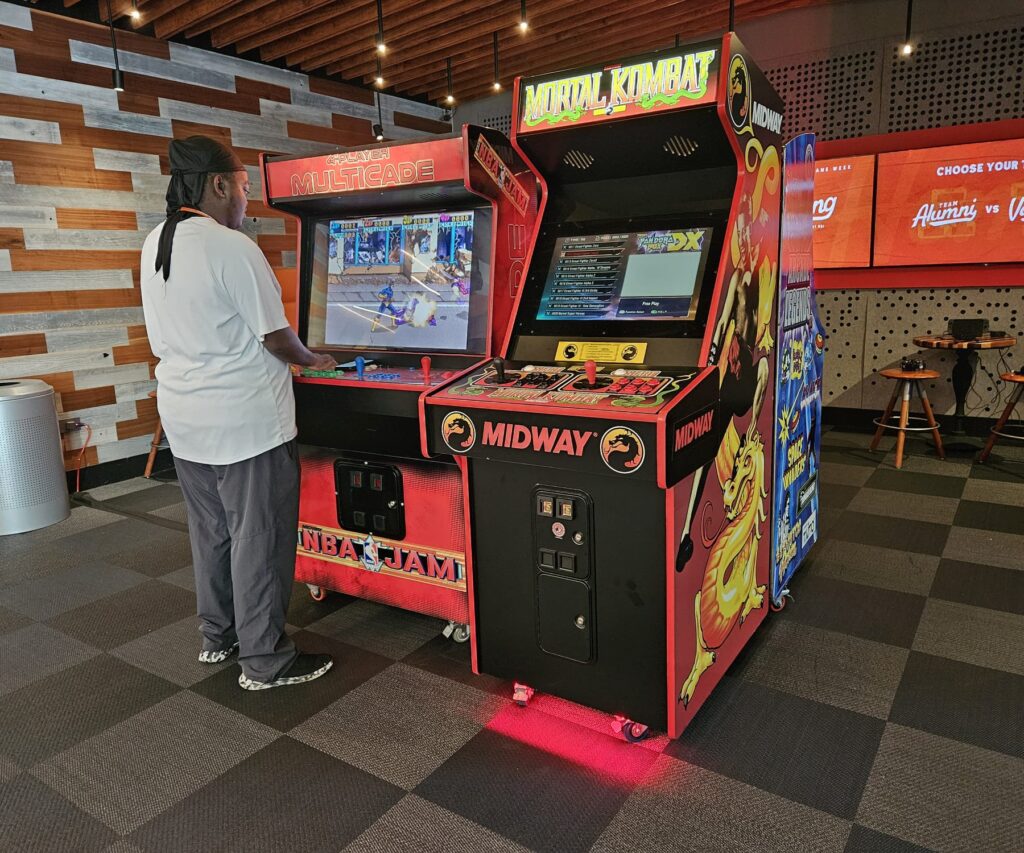
Tetris is famously recognized as one of the early games that started out in Russisa and became a huge global success. The games simplicity makes it easy and addictive, yet difficult to master. Tetris is as well known around the world as games like Pac-Man and Super Mario Bros. Can you name a single game that is as popular as Tetris that originated from Russia. Sea Battle: A submarine-themed game where players use a periscope to target and sink enemy ships. Russia has their own history of video games. The Museum of Soviet Arcade Machines in Moscow and St. Petersburg houses a large collection of these and other Soviet-era arcade games. These games, often produced by defense factories, offer a glimpse into Russia’s unique arcade gaming history and culture.
*Some of the content information above was provided by Wikipedia and KLOV (Killer List of Video Games).
*Visit our main website https://cocktailhourentertainment.com
For More Information fill out our Contact Form