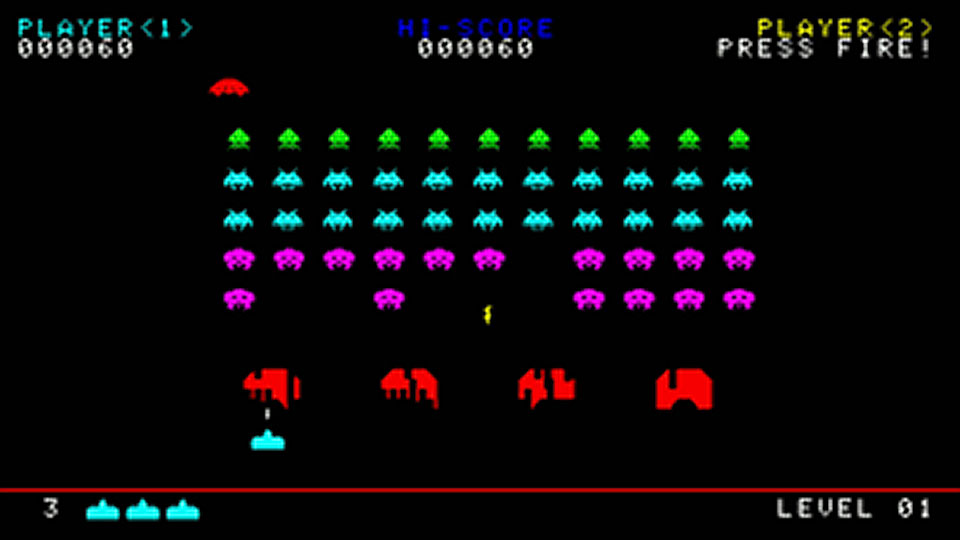
SPACE INVADERS GAME PLAY
Space Invaders is a fixed shooter in which the player moves a laser cannon horizontally across the bottom of the screen and fires at a group of aliens overhead. The aliens begin as five rows of eleven—the amount differs in some versions—that move left and right as a group, advancing on the shooter by shifting downward each time they reach a screen edge. The goal is to eliminate all the aliens by shooting them. Regardless of how many game lives remaining the player has, the game ends if the invaders reach the bottom of the screen.
The aliens attempt to destroy the player’s cannon by firing projectiles. The laser cannon is partially protected by stationary defense bunkers that are gradually destroyed from the top by the aliens; the bottom will be destroyed if the player fires when beneath one. As aliens are defeated, their movement, as well as the accompanying music, speeds up. Defeating all the aliens brings another wave which starts lower, a loop that can continue endlessly. A special “mystery ship” will occasionally move across the top of the screen and award bonus points if destroyed.
Development
Space Invaders was developed by Japanese designer Tomohiro Nishikado, who spent a year designing it and developing the necessary hardware to produce it. Because he worked alone and handmade many of the development tools, the process incured minimal costs. The game was a response to Atari, Inc.‘s 1976 arcade game Breakout. Nishikado noted that Breakout-style games were very popular in Japan in 1977. The developer wanted to adapt the same sense of achievement and tension from destroying targets one at a time, combining it with elements of target shooting games. The game uses a similar layout to that of Breakout but with different game mechanics; rather than bounce a ball to attack static objects, players are given the ability to fire projectiles at moving enemies.
Early enemy designs included tanks, combat planes, and battleships. However, Nishikado was not satisfied with the enemy movements; technical limitations made it difficult to animate flying. The designer believed animating human characters would have been easier to program, but he considered shooting them immoral. Nishikado also said that shooting people was frowned upon. After seeing the release of the 1974 anime Space Battleship Yamato in Japan, released in the US as Star Blazers, and seeing a magazine feature about the 1977 Star Wars movie, he thought of using a space theme. Nishikado drew inspiration for the aliens from a novel by H. G. Wells, The War of the Worlds, and created initial bitmap images after the octopus-like aliens. Other alien designs were modeled after squids and crabs. After creating the pixel art, Nishikado created a tool to animate two frames of movement for each character and adjusted the design on-screen with a light pen. He added the bunkers and the mystery ship to the playing field afterward.
Nishikado added several interactive elements that he found lacking in earlier video games, such as the ability for enemies to react to the player’s movement and fire back, and a game over triggered by the enemies killing the player character (either by getting shot or enemies reaching the bottom of the screen) rather than simply a timer running out. He replaced the timer, typical of arcade games at the time, with descending aliens who effectively served a similar function, where the closer they came, the less time remained for the player. During the process, Nishikado wanted the game’s difficulty to increase the longer the game progressed; he reasoned this kept the gameplay fresh and that the game would earn less if players could play for extended periods. The game was originally titled Space Monsters after a popular song in Japan at the time, “Monster”, but was changed to Space Invaders by the designer’s superiors.
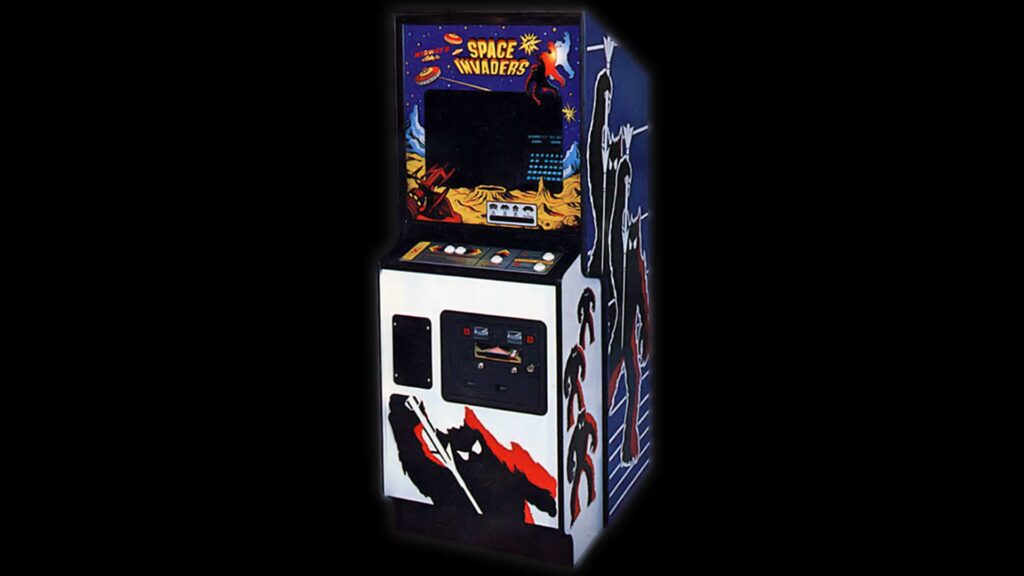
The cabinet artwork features large humanoid monsters absent from the game, which Nishikado attributed to the artist basing the designs on the original “Space Monsters” title rather than referring to the in-game graphics. In the upright cabinets, the graphics are generated on a hidden CRT monitor and reflected toward the player using a semi-transparent mirror, behind which is mounted a plastic cutout of a moon bolted against a painted starry background. The backdrop is visible through the mirror and thus appears “behind” the graphics. Both Taito’s and Midway’s first Space Invaders releases have black-and-white graphics with strips of transparent orange and green cellophane over certain portions of the screen to add color to the image. Later Japanese releases feature a rainbow-colored cellophane overlay, and these were eventually followed by versions with a color monitor and an electronically generated color overlay.
Release
Taito released Space Invaders in July 1978. The company released both an upright arcade cabinet and a cocktail-table cabinet; Taito named the cocktail version T.T. Space Invaders in Japan to indicate it was a “table-top” version. Midway released its upright version a few months later and its cocktail version several months after that. Space Invaders cabinets have since become collector’s items, with the cocktail and cabaret versions the rarest. At the end of 2003, Taito announced plans to produce 10,000 Space Invaders cabinets to sell again for the game’s 25th anniversary.
The 1980 port to the Atari 2600 was the first official licensing of an arcade game for consoles and became the first killer app for home video game consoles after quadrupling the system’s sales. After selling over 1.0 million units in its first year, the Space Invaders port sold over 4.2 million copies by the end of 1981, becoming the best-selling Atari 2600 game until the 1982 Atari version of Pac-Man released. By 1983, the Atari 2600 version had sold almost 6.1 million cartridges. Other official conversions were released for the Atari 8-bit computers and Atari 5200 console, while Taito later released it for the Nintendo Famicom in 1985 exclusively in Japan. By 1982, versions of Space Invaders were available for handheld electronic game devices, tabletop dedicated consoles, home computers, watches and pocket calculators.

More than a hundred Space Invaders video game clones were released for various platforms, such as Super Invader (1979) and TI Invaders (1981); the latter was the top-selling game for the TI-99/4A through at least 1982. Prior to its industry dominance, Nintendo’s foray into arcade games consisted of clones of existing popular games, including the Space Invader clone Space Fever. The influx of clones led to the term “Invader game” to identify the generic classification of games. Unofficial copies dominated the video game market in South Korea. The market demand for hardware to create the machines helped spur the early growth of Korea’s semiconductor industry.
Reception
Space Invaders initially received mixed responses from within Taito and amusement arcade owners. Nishikado’s colleagues praised it, applauding his achievement while queuing up to play, whereas his bosses predicted low sales as games often ended more quickly than other timer-based arcade games at the time. A number of amusement arcade owners initially rejected it, but some pachinko parlors and bowling alleys adopted it; it quickly caught on, with many parlors and alleys clearing space for more Space Invaders cabinets. In the first few months following its release in Japan, Space Invaders became popular to the point that specialty video arcades, referred to as “Space Invaders Parlours” and “Space Invaders Houses”, opened with nothing but Space Invaders cabinets.
A year after its release, Space Invaders had become the arcade game industry’s all-time best-seller. By the end of 1978, Taito had installed over 100,000 machines and grossed $670 million ($3.2 billion adjusted for inflation) in Japan alone. By June 1979, Taito had manufactured about 200,000–300,000 Space Invaders machines in Japan, with each unit earning an average of ¥10,000 or $46 (equivalent to $199 in 2024) in 100 yen coins per day. However, this was not enough to meet the high demand, leading to Taito increasing production to 25,000–30,000 units per month and raising projections to 400,000 manufactured in Japan by the end of 1979. In order to cope with the demand, Taito licensed the overseas rights to Midway for distribution outside of Japan. By the end of 1979, an estimated 750,000 Space Invaders machines were installed worldwide, including 400,000 in Japan, 85,000 in the United Kingdom, and 60,000 within a year in the United States Space Invaders‘ popularity propelled it to become the first game that recouped an arcade machine’s owner in less than a month, with some places seeing profits within one week; prices ranged from $2,000 to $3,000 per machine. The game eventually sold 72,000 units in the United States by 1982.
Space Invaders had about 8 million daily players in Japan, with daily revenue peaking at ¥2.6 billion or $12,000,000 (equivalent to $58,000,000 in 2024). Space Invaders machines had grossed more than four billion US quarters ($1 billion at the time, or $4.8 billion adjusted for inflation) by 1979. It remained the top arcade game for three years through 1980. In 1981, several years after its release, it still had weekly earnings of $7.7 million in the United States, second only to Pac-Man. By 1982, it had crossed $2 billion in quarters (equivalent to $9.64 billion adjusted for inflation), with a net profit of $450 million (equivalent to $2.17 billion adjusted for inflation). This made it the best-selling video game and highest-grossing “entertainment product” of its time, with comparisons made to the then highest-grossing film Star Wars, which had grossed $486 million, with a net profit of $175 million. By 1982, it had grossed $3.8 billion, equivalent to over $13 billion as of 2016. Space Invaders earned Taito profits of over $500,000,000 (equivalent to $2,400,000,000 in 2024). The Arcade Awards ceremony was created that same year to honor the best video games, with Space Invaders winning the first Best Coin-Op Electronic Game award.
Ports have received mixed reviews; the Atari 2600 version was successful, while the Famicom version was poorly received.
Retrospective
In 1995, Flux magazine staff ranked Space Invaders first on their “Top 100 Video Games”. In 1996, Next Generation magazine put Space Invaders at number 97 on their list of the “Top 100 Games of All Time”, saying that it “provides an elegance and simplicity not found in later games like Phoenix [1980].” IGN listed it as one of the “Top 10 Most Influential Games” in 2007, citing it as a source of inspiration to video game designers and the impact it had on the shooting genre. The Times ranked it No. 1 on its list of “The ten most influential video games ever” in 2007. 1UP ranked it at No. 3 on its list of “The 60 Most Influential Games of All Time”, stating that, in contrast to earlier arcade games which “were attempts to simulate already-existing things,” Space Invaders was “the first video game as a video game, instead of merely a playable electronic representation of something else.” Guinness World Records considered Space Invaders one of the most successful arcade shooting games by 2008. In describing it as a “seminal arcade classic”, IGN listed it as the number eight “classic shoot ’em up”.
In 2008, Guinness World Records listed it as the top-rated arcade game in terms of technical, creative, and cultural impact. Entertainment Weekly named Space Invaders one of the top ten games for the Atari 2600 home console in 2013. In 2018, it was ranked 87th in Video Game Canon’s statistical meta-analysis of 48 “top games” lists published between 1995 and 2017. In 2021, The Guardian listed it as the third-greatest video game of the 1970s, just below Galaxian and Asteroids. Space Invaders was inducted into the World Video Game Hall of Fame in 2016.
Remakes and sequels
Space Invaders has been remade on numerous platforms and spawned many sequels. Re-releases include ported and updated versions of the original arcade game. Ported versions generally feature different graphics and additional gameplay options—for example, moving defense bunkers, zigzag shots, invisible aliens, and two-player cooperative gameplay.[10] Ports on earlier systems like the Atari home consoles featured simplified graphics, while later systems such as the Super Nintendo Entertainment System and PlayStation featured updated graphics. Later games include several modes of gameplay and integrate new elements into the original design. For example, Space Invaders Extreme, released on the Nintendo DS and PlayStation Portable, integrated musical elements into the standard gameplay. A 2008 spin-off for WiiWare, Space Invaders Get Even, allows players to control the aliens instead of the laser cannon in a reversal of roles.
In 1980, Bally released a pinball version. However, few elements from the original game are included, and the aliens instead resemble the xenomorphs from the film Alien; Bally was later sued over the resemblance to the designs by H. R. Giger. It became the third highest-grossing pinball machine of 1980 in the United States. A stand-alone version was released by Super Impulse as part of its Tiny Arcade series, along with the Namco games Pac-Man, Ms. Pac-Man, and Galaxian.

Taito has released several arcade sequels. The first was Space Invaders Part II in 1979; it featured color graphics, an attract mode, new gameplay elements, and added an intermission between gameplay. According to the Killer List of Videogames, this was the first video game to include an intermission. The game also allowed the player with the top score to sign their name, which would appear at the top of the screen for as long as the game was powered on. This version was released in the United States as Deluxe Space Invaders (also known as Space Invaders Deluxe), but it featured a different graphical color scheme and a lunar-city background. Another arcade sequel, Space Invaders II, was released exclusively in the United States. It was in a cocktail-table format with very fast alien firing and a competitive two-player mode. During the summer of 1985, Return of the Invaders was released with updated color graphics and more complex movements and attack patterns for the aliens. Subsequent arcade sequels included Super Space Invaders ’91, Space Invaders DX, and Space Invaders ‘95. Each game introduced minor gameplay additions to the original design. Like the original game, several of the arcade sequels have become collector’s items, though some are considered rarer. In 2002, Taito released Space Raiders, a third-person shooter reminiscent of Space Invaders.
Space Invaders and its related games have been included in video game compilations. Space Invaders Anniversary was released in 2003 for the PlayStation 2 and included nine Space Invader variants. A similar game for the PlayStation Portable, Space Invaders Pocket, was released in 2005. Space Invaders, Space Invaders Part II and Return of the Invaders are included in Taito Legends, a compilation of Taito’s classic arcade games released in 2005 on the PlayStation 2, Xbox, and PC. Super Space Invaders ’91, Space Invaders DX, and Space Invaders ‘95 were included in Taito Legends 2, a sequel compilation released in 2006.
IMPACT
The impact of Space Invaders on the video game industry has been compared to that of The Beatles in the pop music industry. Considered “the first ‘blockbuster‘ video game”, Space Invaders became synonymous with video games worldwide for some time. Many publications and websites use the pixelated alien graphic as an icon for video games in general
*Some of the content information above was provided by Wikipedia and KLOV (Killer List of Video Games).
*Visit our main website https://cocktailhourentertainment.com
For More Information fill out our Contact Form