
OUTRUN ARCADE GAME RENTAL
Planning an event with arcade games?
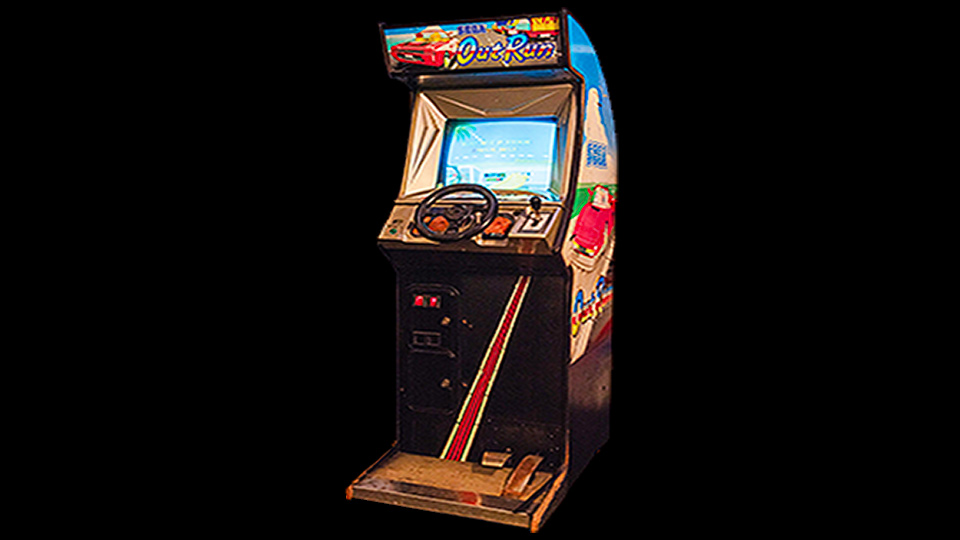
Here’s your chance to rent a real OutRun arcade machine for your next party or event in Florida.
Whether it’s a birthday party, corporate event, or a tradeshow, you can rent your favorite retro arcade machine for your upcoming social function. Rent your favorite retro 1980’s (eighties) classic arcade game rental for your next event in Florida.
Out Run (OutRun) is an arcade driving video game released by Sega in September 1986. It is known for its pioneering hardware and graphics, nonlinear gameplay, a selectable soundtrack with music composed by Hiroshi Kawaguchi, and the hydraulic motion simulator deluxe arcade cabinet. The goal is to avoid traffic and reach one of five destinations before time runs out.
The game was designed by Yu Suzuki, who traveled to Europe to gain inspiration for the game’s stages. Suzuki had a small team and only ten months to program the game, leaving him to do most of the work himself. The game was a critical and commercial success, becoming the highest-grossing arcade game of 1987 worldwide as well as Sega’s most successful arcade cabinet of the 1980s. It was ported to numerous video game consoles and home computers, becoming one of the best-selling video games at the time and selling millions of copies worldwide, and it spawned a number of sequels. Out Run is considered one of the most influential and greatest games ever made, cited as an influence upon numerous later video games, playing a role in the arcade video game industry’s recovery, and providing the name for a popular music genre. It spawned a series and a sequel of sorts was released, Turbo OutRun in 1989 with a real sequel, OutRun 2 released in 2003.
OUTRUN RACING GAME PLAY
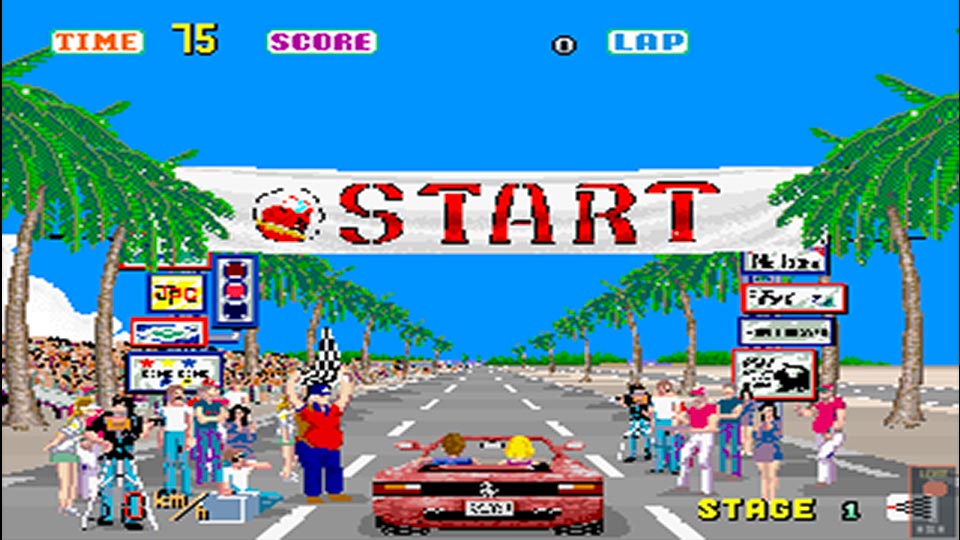
Out Run is a pseudo-3D driving video game in which the player controls a Ferrari Testarossa convertible from a third-person rear perspective.[5] The camera is placed near the ground, simulating a Ferrari driver’s position and limiting the player’s view into the distance. The road curves, crests, and dips,[3] which increases the challenge by obscuring upcoming obstacles such as traffic that the player must avoid.[6] The object of the game is to reach the finish line against a timer.[7] The game world is divided into multiple stages that each end in a checkpoint, and reaching the end of a stage provides more time.[8] Near the end of each stage, the track forks to give the player a choice of routes leading to five final destinations.[9] The destinations represent different difficulty levels and each conclude with their own ending scene, among them the Ferrari breaking down or being presented a trophy.
Development
During the mid-1980s, Sega experienced success in the arcades with games developed by Yu Suzuki. Hang-On was a good seller and Enduro Racer had been successful enough for Sega to consider a second production run. Both are motorcycle racing games, and Out Run was Suzuki’s chance to develop a car racing game. His original concept was to base the game on the American film The Cannonball Run of which he was a fan.He disliked racing games where cars exploded on impact, and wanted gamers to enjoy the experience of driving and to feel “superior”.
Suzuki initially conceived the game’s setting across the United States, and he requested to scout various locations there. According to Suzuki’s boss, Youji Ishii, Sega president Hayao Nakayama believed the US was too unsafe, and suggested Europe as a safer option. Additionally, Suzuki concluded that the US was too “large and empty” for the game’s design. He scouted Europe for two weeks in a BMW 520 for ideas. This tour included Frankfurt, Monaco, Rome, the Swiss Alps, the French Riviera, Florence and Milan. While in Monaco, Suzuki was inspired to use the Ferrari Testarossa as the playable car in the game, so when he returned to Japan he arranged for his team to find and photograph one. They took many photos of the car from every side and recorded the sound of the engine.
A small team of four programmers, a sound creator, and five graphic designers developed Out Run. Suzuki had to use only personnel that were available and not assigned to other projects at the time. As a result, Suzuki did most of the programming and planning himself, spending extra hours at the studio to complete development of the game within ten months. He believed that the most difficult part of developing the game was to make it as fun as possible, which he achieved by emphasizing the design elements of wide roads, buildings, and a radio with soundtrack selection.
Four cabinet designs were released, all of which are equipped with a steering wheel, a stick shift, and acceleration and brake pedals. Two of the cabinet designs are upright, the larger of which has force feedback in the steering wheel. The other two models are sit-down motion simulator cabinets that resemble the in-game car and use a drive motor to move the main cabinet—turning and shaking according to the onscreen action. Both models feature stereo speakers mounted behind the driver’s head. The arcade system board made specifically for the game is the Sega OutRun, based on the Sega System 16. Suzuki said that he was often unable to make games based on existing hardware and that Sega would have to create a new board. He said that his “designs were always 3D from the beginning. All the calculations in the system were 3D, even from Hang-On. I calculated the position, scale, and zoom rate in 3D and converted it backwards to 2D. So I was always thinking in 3D”. The game achieves its 3D effects using a sprite-scaling technique called Super Scaler technology, as used one year earlier in Hang-On. Released in September 1986, Out Run‘s fast sprite-scaling and 3D motion provide a smoother experience than other contemporary arcade games.
Suzuki also set about simulating car features that were previously lacking in earlier driving games, so that being a skillful driver in real life would translate to being skillful in the game. They simulated features such as horsepower, torque, gear ratios and tire engineering close to real cars. They also added AI assistance for features that were difficult to control, such as drifting. For the drifting, they added details such as, if the car’s tires grip the road surface too closely, the car’s handling becomes too twitchy, something that wasn’t appreciated in earlier driving games.
Ports and re-releases
Out Run was released for the Master System in 1987, and the Genesis in 1991. Out Run was ported to the Amstrad CPC, Commodore 64 and ZX Spectrum home computers for the European market. A conversion of Out Run was under development by Hertz for the X68000 but according to former Hertz employee Tsunetomo Sugawara, it was never released due to company management cancelling its development. A 32X version was also reportedly under development by Sega, but was never released.
Ports of the arcade game were released for Game Boy Advance via Sega Arcade Gallery, for Nintendo 3DS via the 3D Classics series on 12 March 2015, and for Nintendo Switch as part of the Sega Ages line on 9 January 2019.
Critical response and accolades
Out Run‘s arcade release received positive reviews and became one of the most popular arcade games of the year. The game won the 1987 Golden Joystick Award for Game of the Year, as well as for Arcade Game of the Year. It also won “Best Visual Enhancement in a Video Game” at the 1986 Amusement Players Association’s Players Choice Awards. Clare Edgeley reviewed the arcade game in both Computer and Video Games and in Sinclair User, praising the graphics and the element of danger in the gameplay as well as the hydraulic motion simulator cabinet. Top Score newsletter called it “the most enjoyable” and “realistic driving video game ever created” while praising its innovative simulator cabinet, detailed visuals and stereo soundtrack. A review in Commodore User described it as “a great game for driving enthusiasts” and awarded it a score of 9 out of 10. Gary Penn, writing for Crash called the game “highly polished” and praised the attention to detail. In Your Sinclair, Peter Shaw praised its realism and described it as “the most frighteningly fast road race game” he had played.
Out Run was ported to numerous home consoles and computers. Computer and Video Games praised the Master System release, with the writers concluding that it had “all the thrill power of the arcade version”. The Games Machine gave the Master System version a score of 72%, stating that the Master System version came closest to the original coin-op. Reviewers for Dragon described it as a “refreshing” game “that provides hours of entertainment”. Computer Gaming World named it as the year’s best arcade translation for Sega. Reactions to the 16-bit versions were generally positive. The Atari ST version (1988) was described by Computer and Video Games as “far from perfect”, but that it came closer to the arcade original than the other ports. The 1991 Sega Genesis version also received positive reviews, scoring 90% from French gaming magazines Joypad and Joystick, as well as an 85% from Swedish magazine Svenska Hemdatornytt.
The reception for the 8-bit personal computer ports by U.S. Gold was mixed. The ZX Spectrum version received positive scores from Your Sinclair and Sinclair User. Some reviewers at Crash expressed disappointment at the low quality in contrast to the arcade original. The Games Machine gave the Spectrum version a score of 61%, noting the machine’s technical limitations in comparison to the Master System and Commodore systems. The Commodore versions received positive to average reviews, though Computer and Video Games described the Commodore 64 port as “rushed”. The Amstrad CPC port received a score of 8 out of 40 from Computer and Video Games, which described it as a “travesty”, and a 37% score from Amstrad Action where the reviewer considered it one of the worst arcade conversions ever.
Out Run was followed by various sequels, including three arcade sequels Turbo OutRun (1989), OutRunners (1992) and OutRun 2 (2003), and several non-arcade sequels including Out Run 3-D (1988), Out Run Europa (1991), OutRun 2019 (1993) and later OutRun 2006: Coast 2 Coast (2006). Sega also developed Rad Mobile (1991) which is similar to Out Run.
*Some of the content information above was provided by Wikipedia and KLOV (Killer List of Video Games).
*Visit our main website https://cocktailhourentertainment.com
For More Information fill out our Contact Form
WHY RENT YOUR FAVORITE GAMES FROM US?
If you’re planning an event in Florida we’re your one-stop-shop for “extra” entertainment.
PACKAGE DISCOUNTS
Rent 3 or more games and get a special discount.
BIGGEST SELECTION
Florida’s largest selection of games for rent.
COMPETITIVE PRICING
The best pricing in Florida for game rentals.
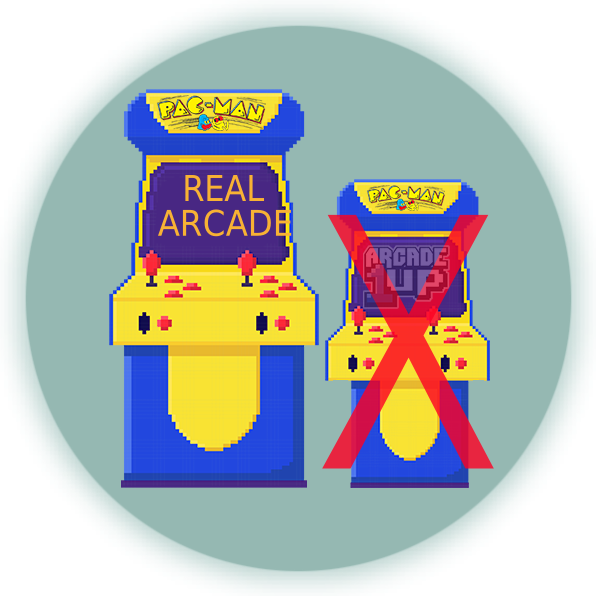
REAL ARCADE MACHINES
We rent real arcade machines, not Arcade1Up toys from walmart.
WE ARE A FLORIDA BASED RENTAL COMPANY
Always hire a local event company, not a company located out of state! Why? The further a company has to travel the more likely something could go wrong. Most out of state companies work from a rolodex. They put adds in every state and make a nice website creating the illusion they are local, but they’re based in another state such as New York or New Jersey. This is why their price is higher. Did you know they usually subcontract a local company like us because it’s easier and cheaper for them. We love being trusted to do this and we will only give out their business cards so you’d never know. Hire us directly for less!

Smart Recommendations
Trust the company hired by the Ritz Carlton, Four Season, The Breakers, Miami Heat, Orlando Magic, and so many others for their corporate events.
- Party Planners trust us for their gaming needs.
- Local and out of state DMCs trust us for their retro entertainment.
- DJ companies, Bands, Caterers, Decorators, and even our competitors call us!

“Rent BURGERTIME now!"
“Rent BURGERTIME now!"
A few of our customers: