
ASTEROIDS ARCADE GAME RENTAL
Planning an event with arcade games?
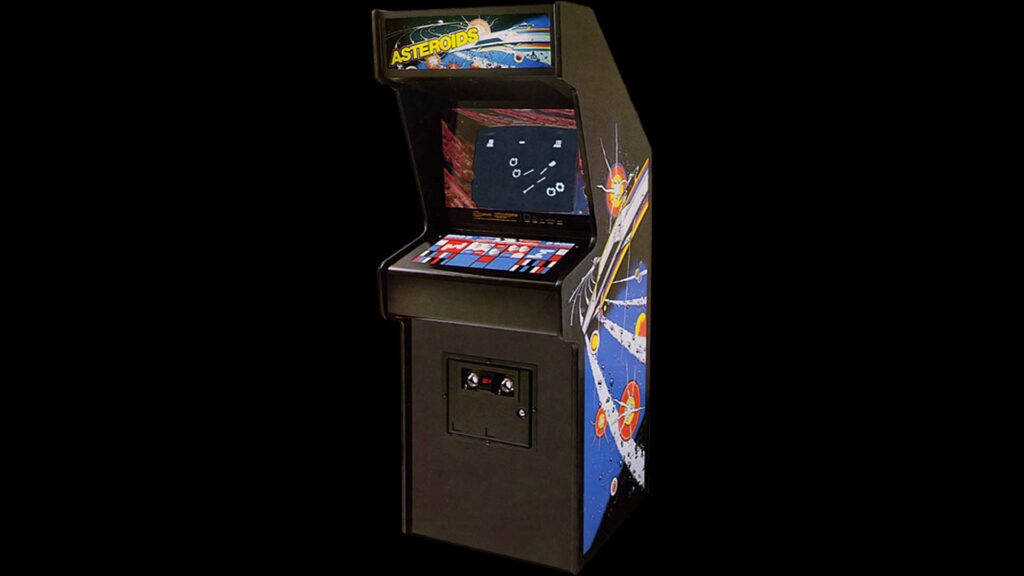
Here’s your chance to rent an old classic, a real Asteroids arcade machine game for your next party or event in Florida.
Whether it’s a birthday party, corporate event, or a tradeshow, you can rent your favorite retro arcade machine for your upcoming social function. Rent your favorite retro 1980’s (eighties) classic arcade game rental for your next event in Florida.
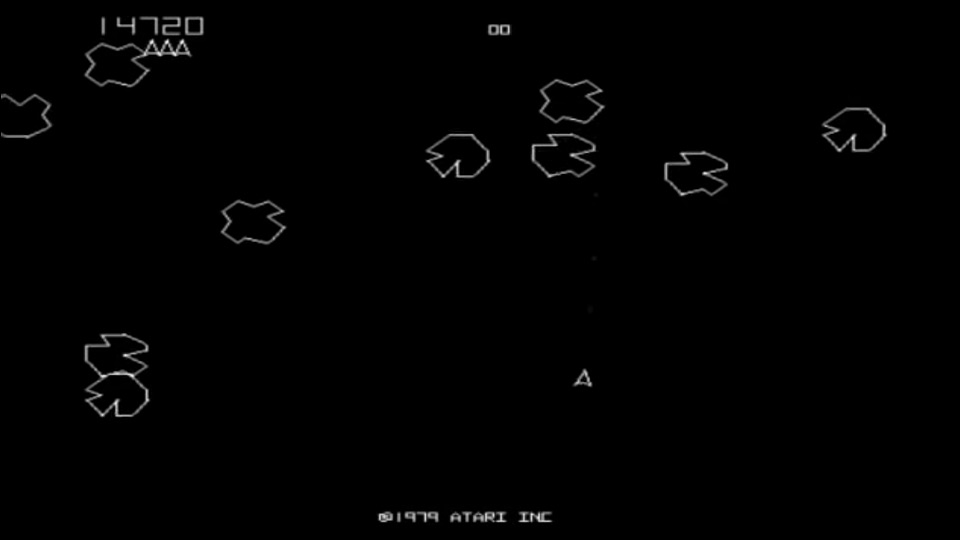
Asteroids is a 1979 multidirectional shooter video game developed and published by Atari, Inc. for arcades. The player controls a single spaceship in an asteroid field which is periodically traversed by flying saucers. The object of the game is to shoot and destroy the asteroids and saucers, while not colliding with either, or being hit by the saucers’ counter-fire. The game becomes more difficult as the number of asteroids increases.
Asteroids was conceived and designed by Lyle Rains and Ed Logg, who decided to use hardware developed by Wendi Allen (then known as Howard Delman) that was previously used for Lunar Lander. Asteroids was based on an unfinished game titled Cosmos; its physics model, control scheme, and gameplay elements were derived from Spacewar!, Computer Space, and Space Invaders and refined through trial and error. The game is rendered on a vector display in a two-dimensional view that wraps around both screen axes.
Asteroids was one of the first major hits of the golden age of arcade games; the game sold 47,840 upright cabinets and 8,725 cocktail cabinets and proved both popular with players and influential with developers. In the 1980s it was ported to Atari’s home systems, and the Atari VCS version sold over three million copies. The game was widely imitated, and it directly influenced Defender, Gravitar, and many other video games.
ASTEROIDS GAME PLAY
The objective of Asteroids is to destroy asteroids and saucers. The player controls a triangular ship that can rotate left and right, fire shots straight forward, and thrust forward. Once the ship begins moving in a direction, it will continue in that direction for a time without player intervention unless the player applies thrust in a different direction. The ship eventually comes to a stop when not thrusting. The player can also send the ship into hyperspace, causing it to disappear and reappear in a random location on the screen, at the risk of self-destructing or appearing on top of an asteroid.
Each level starts with multiple large asteroids drifting across the screen. Objects wrap around screen edges; an asteroid that drifts off the top edge of the screen reappears at the bottom and continues moving in the same direction. As the player shoots asteroids, they break into smaller asteroids that move faster and are more difficult to hit. Smaller asteroids are also worth more points. Two flying saucers appear periodically on the screen; the “big saucer” shoots randomly and poorly, while the “small saucer” fires frequently at the ship. After reaching a score of 40,000, only the small saucer appears. As the player’s score increases, the angle range of the shots from the small saucer diminishes until the saucer fires extremely accurately. Once the screen has been cleared of all asteroids and flying saucers, a new set of large asteroids appears, thus starting the next level. The game gets harder as the number of asteroids increases until after the score reaches a range between 40,000 and 60,000. The player starts with 3–5 lives upon game start and gains an extra life per 10,000 points. Play continues to the last ship lost, which ends the game. The machine “turns over” at 99,990 points, which is the maximum high score that can be achieved.
Lurking exploit
In the original game design, saucers were supposed to begin shooting as soon as they appeared, but this was changed. Additionally, saucers can only aim at the player’s ship on-screen; they are not capable of aiming across a screen boundary. These behaviors allow a “lurking” strategy, in which the player stays near the edge of the screen opposite the saucer. By keeping just one or two rocks in play, a player can shoot across the boundary and destroy saucers to accumulate points indefinitely with little risk of being destroyed. Arcade operators began to complain about losing revenue due to this exploit. In response, Atari issued a patched EPROM and, due to the impact of this exploit, Atari (and other companies) changed their development and testing policies to try to prevent future games from having such exploits.Asteroids Reception
Asteroids was immediately successful upon release. It displaced Space Invaders by popularity in the United States and became Atari’s best-selling arcade game of all time, with over 70,000 units sold. Atari earned an estimated $150 million in sales from the game, and arcade operators earned a further $500 million from coin drops. Atari had been in the process of manufacturing another vector game, Lunar Lander, but demand for Asteroids was so high “that several hundred Asteroids games were shipped in Lunar Lander cabinets”. Asteroids was so popular that some video arcade operators had to install large boxes to hold the number of coins spent by players, and Atari assembly line workers that ignored other games they built played finished Asteroids machines awaiting shipping. It replaced Space Invaders at the top of the US RePlay amusement arcade charts in April 1980, though Space Invaders remained the top game at street locations. Asteroids went on to become the highest-grossing arcade video game of 1980 in the United States, dethroning Space Invaders. It shipped 70,000 arcade units worldwide in 1980, including over 60,000 sold in the United States that year, and grossed about $700 million worldwide ($3 billion adjusted for inflation) by 1980. The game remained at the top of the US RePlay charts through March 1981. The game did not perform as well overseas in Europe and Asia. It sold 30,000 arcade units overseas, for a total of 100,000 arcade units sold worldwide. Atari manufactured 76,312 units from its US and Ireland plants, including 21,394 Asteroids Deluxe units. It was a commercial failure in Japan when it released there in 1980, partly due to its complex controls and partly due to the Japanese market beginning to lose interest in space shoot ’em ups at the time.
Asteroids received positive reviews from critics, and has been regarded as Logg’s magnum opus. Richard A. Edwards reviewed the 1981 Asteroids home cartridge in The Space Gamer No. 46. Edwards commented that “this home cartridge is a virtual duplicate of the ever-popular Atari arcade game. […] If blasting asteroids is the thing you want to do then this is the game, but at this price I can’t wholeheartedly recommend it”. Video Games Player magazine reviewed the Atari VCS version, rating the graphics and sound a B, while giving the game an overall B+ rating. Electronic Fun with Computers & Games magazine gave the Atari VCS version an A rating.
William Cassidy, writing for GameSpy‘s “Classic Gaming”, noticed its innovations, including being one of the first video games to track initials and allow players to enter their initials for appearing in the top 10 high scores, and commented that “the vector graphics fit the futuristic outer space theme very well”. In 1995, Flux magazine ranked the arcade version 11th on their “Top 100 Video Games”. In 1996, Next Generation listed it as number 39 on their “Top 100 Games of All Time”, particularly lauding the control dynamics which require “the constant juggling of speed, positioning, and direction”. In 1999, Next Generation listed Asteroids as number 29 on their “Top 50 Games of All Time”, commenting that “Asteroids was a classic the day it was released, and it has never lost any of its appeal”. Asteroids was ranked fourth on Retro Gamer‘s list of “Top 25 Arcade Games”; the Retro Gamer staff cited its simplicity and the lack of a proper ending as allowances of revisiting the game. In 2012, Asteroids was listed on Time‘s All-Time 100 greatest video games list. Entertainment Weekly named Asteroids one of the top ten games for the Atari 2600 in 2013. It was added to the Museum of Modern Art‘s collection of video games. In 2021, The Guardian listed Asteroids as the second greatest video game of the 1970s, just below Galaxian (1979). By contrast, in March 1983 the Atari 8-bit port of Asteroids won sixth place in Softline‘s Dog of the Year awards “for badness in computer games”, Atari division, based on reader submissions.
Usage of the names of Saturday Night Live characters “Mr. Bill” and “Sluggo” to refer to the saucers in an Esquire article about the game led to Logg receiving a cease and desist letter from a lawyer with the “Mr. Bill Trademark”.
Arcade sequels
Released in 1981, Asteroids Deluxe was the first sequel to Asteroids. Dave Shepperd edited the code and made enhancements to the game without Logg’s involvement. The onscreen objects are tinted blue, and hyperspace is replaced by a shield that depletes when used. The asteroids rotate, and new “killer satellite” enemies break into smaller ships that home in on the player’s position. The arcade machine’s monitor displays vector graphics overlaying a holographic backdrop. The game is more difficult than the original and enables saucers to shoot across the screen boundary, eliminating the lurking strategy for high scores in the original.
Space Duel, released in arcades in 1982, replaces the rocks with colorful geometric shapes and adds cooperative two-player gameplay.
1987’s Blasteroids includes power-ups, ship morphing, branching levels, bosses, and the ability to dock ships in multiplayer for added firepower. Blasteroids uses raster graphics instead of vectors.
Asteroids Re-releases
The game is half of the Atari Lynx pairing Super Asteroids & Missile Command and included in the 1993 Microsoft Arcade compilation.
Activision published an enhanced version of Asteroids for the PlayStation (1998), Nintendo 64 (1999), Microsoft Windows (1998), Game Boy Color (1999), and Mac (2000). The Atari Flashback series of dedicated video game consoles have included both the 2600 and the arcade versions of Asteroids.
Asteroids Hyper 64 made the ship and asteroids 3D, and added new weapons and a multiplayer mode. It was developed by Syrox Developments and published by Crave Entertainment for the Nintendo 64.
A technical demo of Asteroids was developed by iThink for the Atari Jaguar but was never released. Unofficially referred to as Asteroids 2000, it was demonstrated at E-JagFest 2000. An updated version of the game was announced in 2018 for the Intellivision Amico.
Different versions of Asteroids were included in several Atari games compilations, such as Atari Anniversary Edition (2001) for the Dreamcast, PlayStation, and Microsoft Windows, Atari Anthology (2003) for both Xbox and PlayStation 2, Atari Greatest Hits Volume 1 (2010) for the Nintendo DS, Atari Collection 1 and 2 in 2020 for the Evercade, and Atari 50 (2022) for the Atari VCS, Nintendo Switch, PlayStation 4, PlayStation 5, Windows, Xbox One, and Xbox Series X/S.
Released in November 2007, the Xbox Live Arcade port of Asteroids has revamped HD graphics along with an added intense “throttle monkey” mode. The arcade and 2600 versions were made available through Microsoft‘s Game Room service in 2010. Glu Mobile released an enhanced mobile phone port.
In 2005 Asteroids was released for the Game Boy Advance with Pong and Yars’ Revenge also being included on the same package.
A remake, Asteroids: Recharged, was released in December 2021 for the Nintendo Switch, PlayStation 4, PlayStation 5, Windows, Xbox One, and Xbox Series X/S, developed by Adamvision Studios and SneakyBox and published by Atari.
In November 2024, Alan-1 Inc. released an official coin-op arcade version of Asteroids Recharged. The game won the first place in Best New Product of the category Games and Devices of the IAAPA 2024 Brass Ring Awards.
*Some of the content information above was provided by Wikipedia and KLOV (Killer List of Video Games).
*Visit our main website https://cocktailhourentertainment.com
For More Information fill out our Contact Form
WHY RENT YOUR FAVORITE CLASSIC ARCADE GAME FROM US?
If you’re planning an event in Florida we’re your one-stop-shop for “extra” entertainment.
PACKAGE DISCOUNTS
Rent 3 or more classic arcade games and get a special discount.

BIGGEST SELECTION
Florida’s largest selection of classic arcade games for rent.

COMPETITIVE PRICING
The best pricing in Florida for classic arcade game rentals.
REAL ARCADE MACHINES
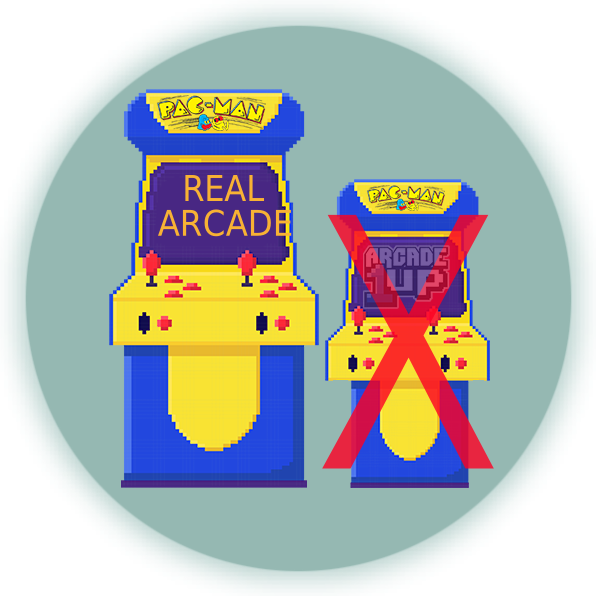
We rent real arcade machines, not Arcade1Up toys from walmart.
WE ARE A FLORIDA BASED RENTAL COMPANY
Always hire a local game rental company, not a game rental company located out of state! Why? The further a company has to travel the more likely something could go wrong. Most out of state game rental companies work from a rolodex. They put adds in every state and make a nice website creating the illusion they are local, but they’re based in another state such as New York or New Jersey. This is why their price is higher. Did you know they usually subcontract a local company like us because it’s easier and cheaper for them. We love being trusted to do this and we will only give out their business cards so you’d never know. Hire us directly for less!

Smart Recommendations
Trust the company hired by the Ritz Carlton, Four Season, The Breakers, Miami Heat, Orlando Magic, and so many others for their corporate events.
- Party Planners trust us for their game rental needs.
- Local and out of state DMCs trust us as a reliable source for game rentals.
- DJ companies, Bands, Caterers, Decorators, and even our competitors call us!
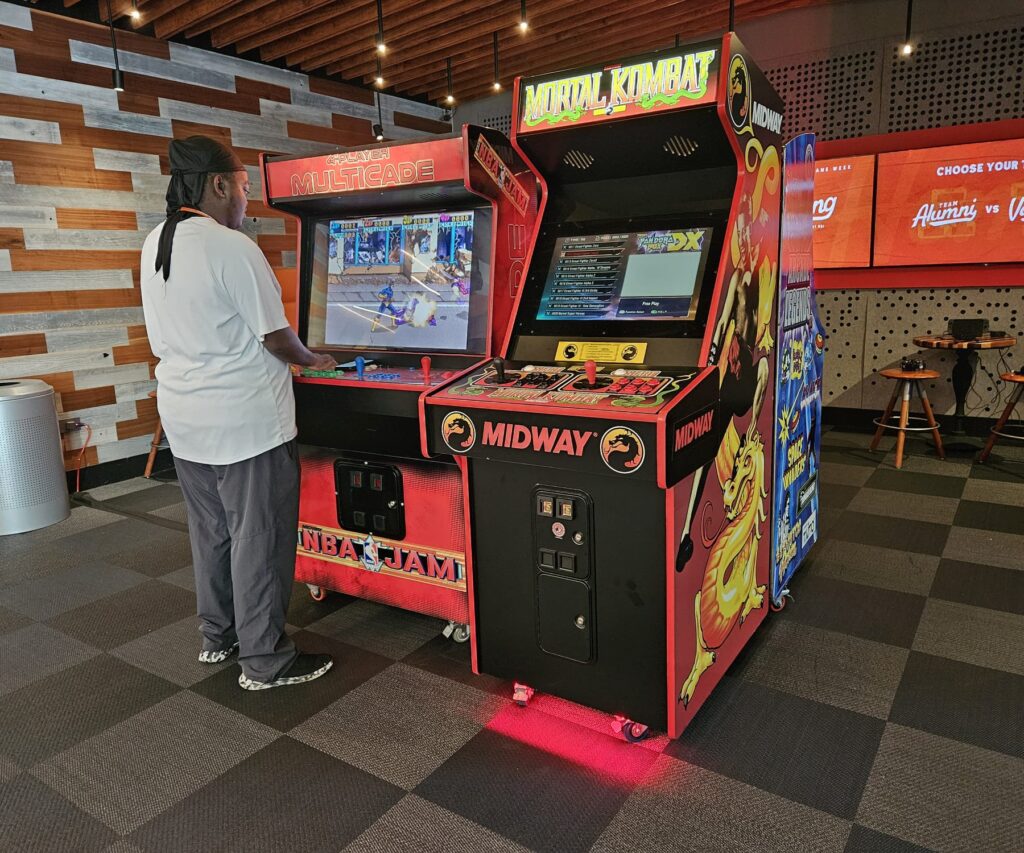

“Rent your ASTEROIDS classic arcade machine now!"
“Rent your ASTEROIDS classic arcade machine now!"
A few of our customers: