
DIG DUG ARCADE GAME RENTAL
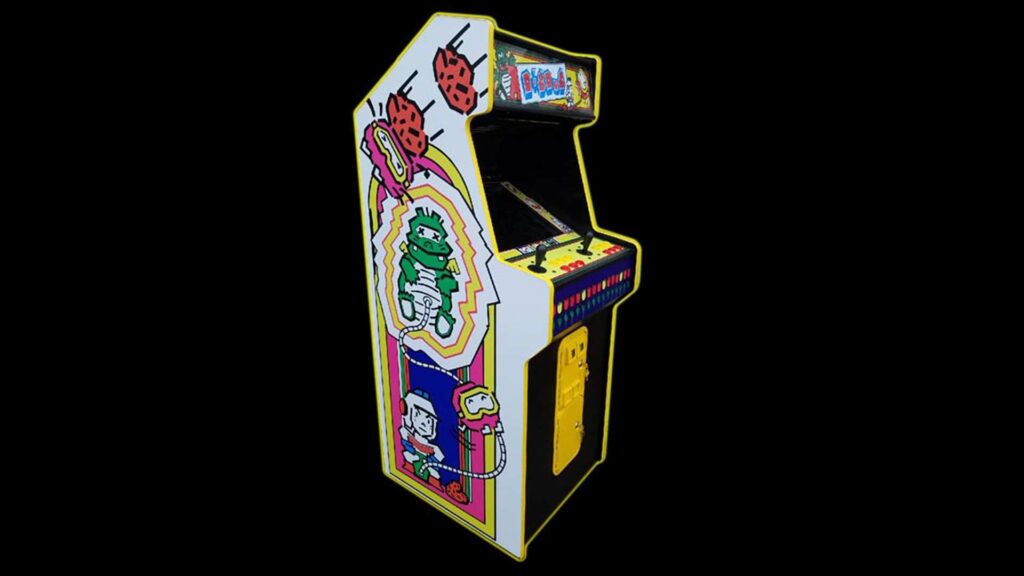
Planning an event with arcade games?
Here’s your chance to rent an old classic, a real Dig Dug arcade machine game for your next party or event in Florida.
Whether it’s a birthday party, corporate event, or a tradeshow, you can rent your favorite retro arcade machine for your upcoming social function. Rent your favorite retro 1980’s (eighties) classic arcade game rental for your next event in Florida.
Dig Dug is a maze arcade video game released by Namco in 1982. It was distributed in North America by Atari, Inc. The player digs underground tunnels to attack enemies in each level, by either inflating them to bursting or crushing them underneath rocks.
Dig Dug was planned and designed by Masahisa Ikegami, with help from Galaga creator Shigeru Yokoyama. It was programmed for the Namco Galaga arcade board by Shouichi Fukatani, who worked on many of Namco’s earlier arcade games, along with Toshio Sakai. Music was composed by Yuriko Keino, including the character movement jingle at executives’ request, as her first Namco game. Namco heavily marketed it as a “strategic digging game”.
Upon release, Dig Dug was well received by critics for its addictive gameplay, cute characters, and strategy. During the golden age of arcade video games, it was globally successful, including as the second highest-grossing arcade game of 1982 in Japan. It prompted a long series of sequels and spin-offs, including the Mr. Driller series, for several platforms. It is in many Namco video game compilations for many systems.
DIG DUG GAME PLAY
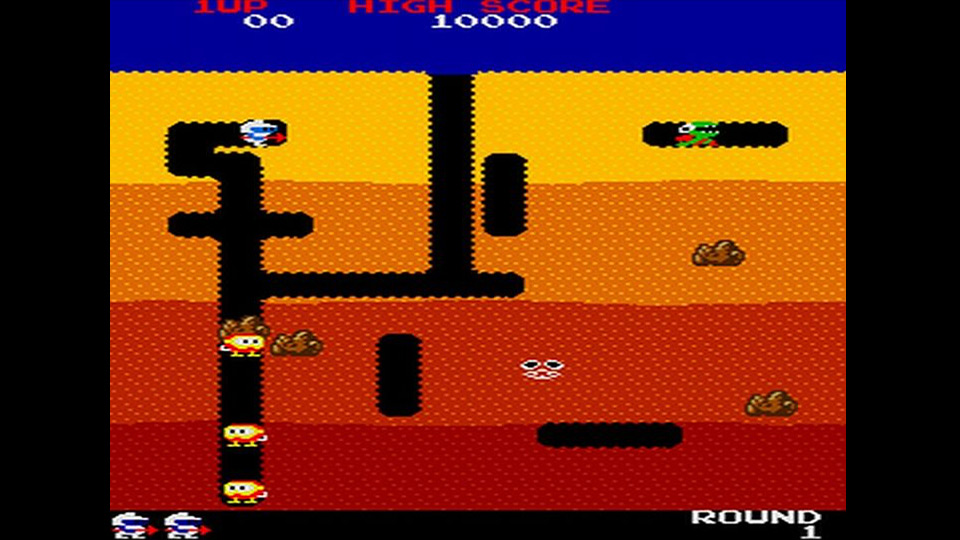
Dig Dug is a maze video game where the player controls protagonist Dig Dug (Taizo Hori) to eliminate each screen’s enemies: Pookas, red creatures with comically large goggles; and Fygars, fire-breathing green dragons. Dig Dug can use an air pump to inflate them to bursting or crush them under large falling rocks. When the air pump is activated, Dig Dug will stop moving and throw the end of the air pump forwards, where it may catch onto an enemy. If an enemy is hit, they are frozen in place, and the player can repeatedly press the air pump’s button to inflate them. If no action is taken for a while or the player moves, the air pump disconnects and the action is cancelled, but the enemy will begin to deflate and will be stunned until fully deflated. Rocks are unable to be dug through but will fall after a short period of time after the tile directly beneath them is removed by Dig Dug and he moves from the position, though he can still be crushed. Falling rocks are destroyed once they land on a tile. Bonus points are awarded for squashing multiple enemies with a single rock, and dropping any two rocks in a stage yields a bonus item, which can be eaten for points. Once all the enemies have been defeated, Dig Dug progresses to the next stage.
Enemies can move through tiles, where they are represented in the form of ghostly eyes, and are invulnerable, slowed, and unable to attack, and will then return to being solid once in an empty space, whether that space is their destination or is along the way. The enemies can either do this to reach Dig Dug when they would otherwise be unable to or to escape from the stage as the last enemy. As enemies are defeated, the enemies eventually become faster and more aggressive, until the last one then attempts to escape on either side of the screen at the top of the stage. To escape, enemies will move straight up through any tiles before walking towards the nearest screen edge on the surface.
The game has 256 stages. Later stages vary in dirt color, while increasing the number and speed of enemies. Lives are lost upon touching a foe, Fygar’s fire or getting squished by a falling rock. Players are given extra lives during the game, but at 900K points they must endure a “survival of the fittest” mode to the last Dig Dug, which ends the game.
DIG DUG Game Release
Dig Dug was released in 1982, in Japan on February 20, in North America in April by Atari (as part of the licensing deal with Namco), and in Europe on April 19 by Namco.
The first home conversion of Dig Dug was released for the Atari 2600 in October 1983, developed and published by Atari, which was followed by versions for the Atari 5200 (October 1983), TI-99/4A (December 1983), Atari 8-bit computers, Commodore 64, IBM PC, and Apple II (December 1984). In Japan, it was ported to the Casio PV-1000 in 1983, the MSX in 1984, and the Famicom on June 4, 1985.[18] Gakken produced a handheld LCD tabletop game in 1983, which replaced Dig Dug’s air pump with a flamethrower to accommodate hardware limitations. Namco released a Game Boy conversion in North America only in September 1992, with an all-new game called “New Dig Dug” where the player must collect keys to open an exit door; this version was later included in the 1996 Japan-only compilation Namco Gallery Vol. 2, which also includes Galaxian, The Tower of Druaga, and Famista 4. A Japanese X68000 version was developed by Dempa and released on February 24, 1995, bundled with Dig Dug II. The Famicom version was re-released in Japan for the Game Boy Advance in 2004 as part of the Famicom Mini series.
Dig Dug is a mainstay in Namco video game compilations, including Namco Museum Vol. 3 (1996), Namco History Vol. 3 (1998), Namco Museum 64 (1999), Namco Museum 50th Anniversary (2005), Namco Museum Remix (2007), Namco Museum Essentials (2009), and Namco Museum Switch (2017). The game was released online on Xbox Live Arcade in 2006, supporting online leaderboards and achievements. It is part of Namco Museum Virtual Arcade, and was added to the Xbox One‘s backward compatibility lineup in 2016.[29] A version for the Japanese Wii Virtual Console was released in 2009. Dig Dug is a bonus game in Pac-Man Party, alongside the arcade versions of Pac-Man and Galaga.
DIG DUG RECEPTION
Dig Dug was a critical and commercial success upon release, and was praised for its gameplay and layered strategy. In Japan, it was the second highest-grossing arcade game of 1982, behind Namco’s own Pole Position. In North America, Atari sold 22,228 Dig Dug arcade cabinets by the end of 1982, earning $46,300,000 (equivalent to $151,000,000 in 2024) in cabinet sales. Around July 1983, it was one of the six top-grossing games. It was popular during the golden age of arcade video games. The 2004 Famicom Mini release had 58,572 copies sold, and the Xbox Live Arcade version had 222,240 copies by 2011.
American publication Blip Magazine favorably compared it to games such as Pac-Man for its simple controls and fun gameplay. AllGame called it “an arcade and NES classic”, praising its characters, gameplay, and unique premise, and for its easy home platform conversion. In 1998, Japanese magazine Gamest called it one of the greatest arcade games of all time for its addictiveness and for breaking the traditional “dot-eater” gameplay used in games such as Pac-Man and Rally-X.[45] In a 2007 retrospective, Eurogamer praised its “perfect” gameplay and strategy, saying it is one of “the most memorable and legendary videogame releases of the past 30 years”. The Killer List of Videogames rated it the sixth-most-popular coin-op game of all time.
Electronic Fun with Computers & Games praised the Atari 8-bit version for retaining the arcade’s entertaining gameplay and for its simple controls.
Some home versions were criticized for quality and lack of exclusive content. Readers of Softline magazine ranked Dig Dug the tenth-worst Apple II and fourth-worst Atari 8-bit video game of 1983 for its subpar quality and failure of consumer expectations.
Reviewing the Xbox Live Arcade digital re-release, IGN liked its presentation, leaderboards, and addictive gameplay, recommending it for old and new fans alike. A similar response was echoed by GameSpot for its colorful artwork and faithful arcade gameplay and by Eurogamer for addictiveness and longevity. Eurogamer, IGN, and GameSpot all criticized its lack of online multiplayer and for achievements being too easy to unlock, with Eurogamer in particular criticizing the game’s controls for sometimes being unresponsive.
*Some of the content information above was provided by Wikipedia and KLOV (Killer List of Video Games).
*Visit our main website https://cocktailhourentertainment.com
For More Information fill out our Contact Form
WHY RENT YOUR FAVORITE CLASSIC ARCADE GAME FROM US?
If you’re planning an event in Florida we’re your one-stop-shop for “extra” entertainment.

PACKAGE DISCOUNTS
Rent 3 or more classic arcade games and get a special discount.

BIGGEST SELECTION
Florida’s largest selection of classic arcade games for rent.
COMPETITIVE PRICING
The best pricing in Florida for classic arcade game rentals.
REAL ARCADE MACHINES
We rent real arcade machines, not Arcade1Up toys from walmart.
WE ARE A FLORIDA BASED RENTAL COMPANY
Always hire a local game rental company, not a game rental company located out of state! Why? The further a company has to travel the more likely something could go wrong. Most out of state game rental companies work from a rolodex. They put adds in every state and make a nice website creating the illusion they are local, but they’re based in another state such as New York or New Jersey. This is why their price is higher. Did you know they usually subcontract a local company like us because it’s easier and cheaper for them. We love being trusted to do this and we will only give out their business cards so you’d never know. Hire us directly for less!

Smart Recommendations
Trust the company hired by the Ritz Carlton, Four Season, The Breakers, Miami Heat, Orlando Magic, and so many others for their corporate events.
- Party Planners trust us for their game rental needs.
- Local and out of state DMCs trust us as a reliable source for game rentals.
- DJ companies, Bands, Caterers, Decorators, and even our competitors call us!
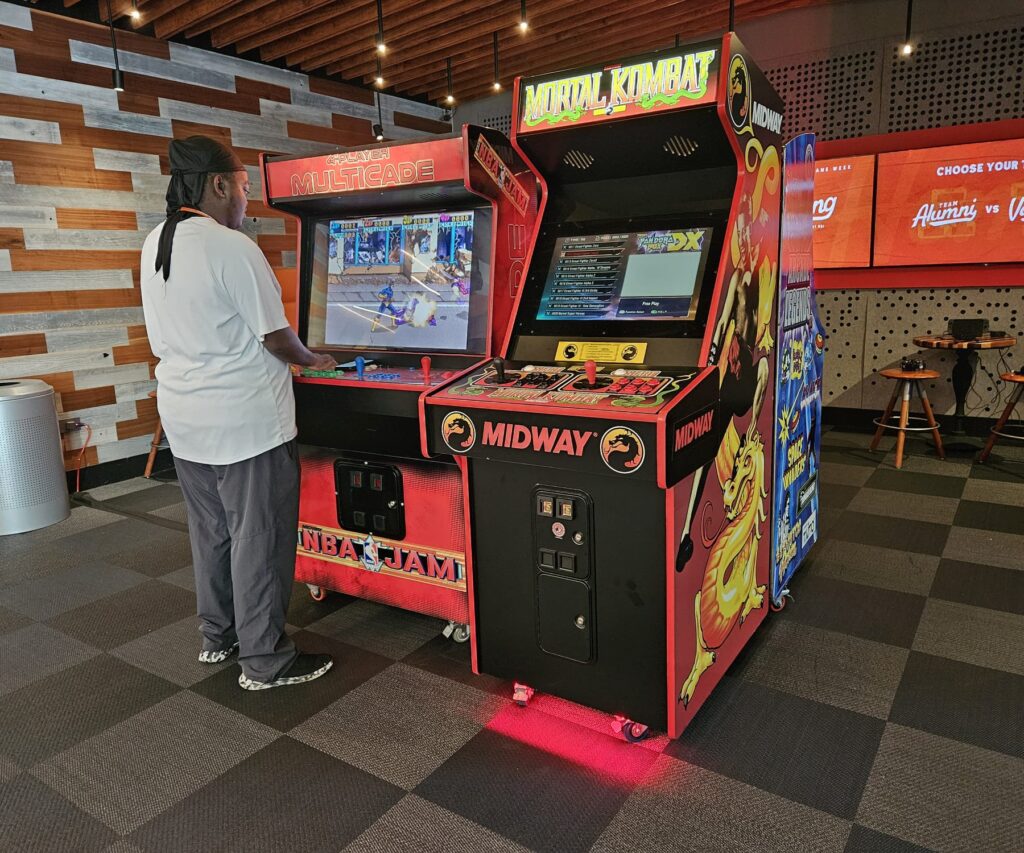

“Rent your DIG DUG classic arcade machine now!"
“Rent your DIG DUG classic arcade machine now!"
A few of our customers: