
GAUNTLET ARCADE GAME RENTAL
Planning an event with arcade games?
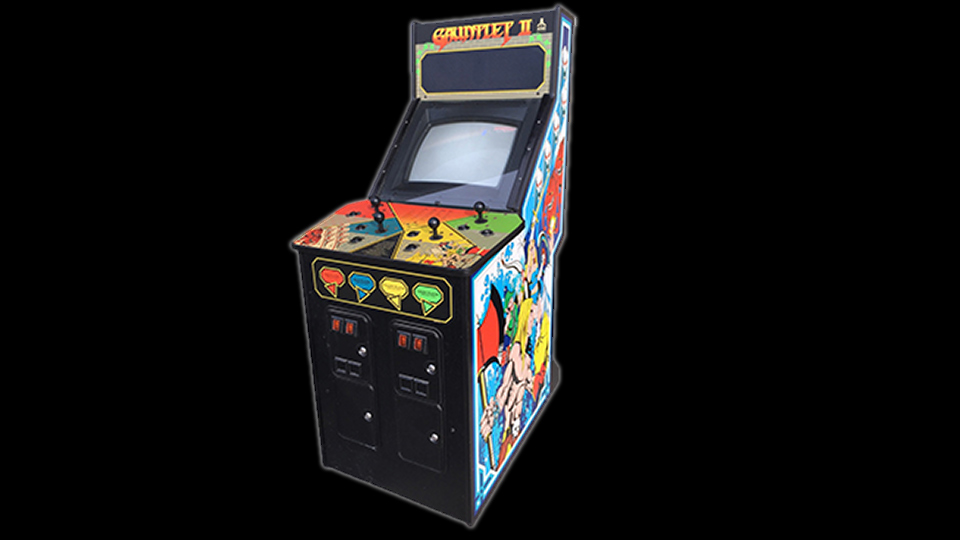
Here’s your chance to rent an old classic, a real Gauntlet classic arcade machine game for your next party.
Whether it’s a birthday party, corporate event, or a tradeshow, you can rent your favorite retro arcade machine for your upcoming social function. Rent your favorite retro 1980’s (eighties) classic arcade game rental for your next event in Florida.
Gauntlet is an old 1985 fantasy-themed hack-and-slash arcade video game developed and released by Atari Games. It is one of the first multiplayer dungeon crawl arcade games. The core design of Gauntlet comes from 1983 game Dandy for the Atari 8-bit computers, which resulted in a threat of legal action. It also has similarities to the action-adventure maze video game Time Bandit (1983).
The arcade version of Gauntlet was released in November 1985 and was initially available only as a dedicated 4-player cabinet. Atari distributed a total of 7,848 arcade units. In Japan, the game was released by Namco in February 1986. Atari later released a two-player cabinet variant in June 1986, aimed at operators who could not afford or did not have sufficient space for the 4-player version.
GAUNTLET GAME PLAY
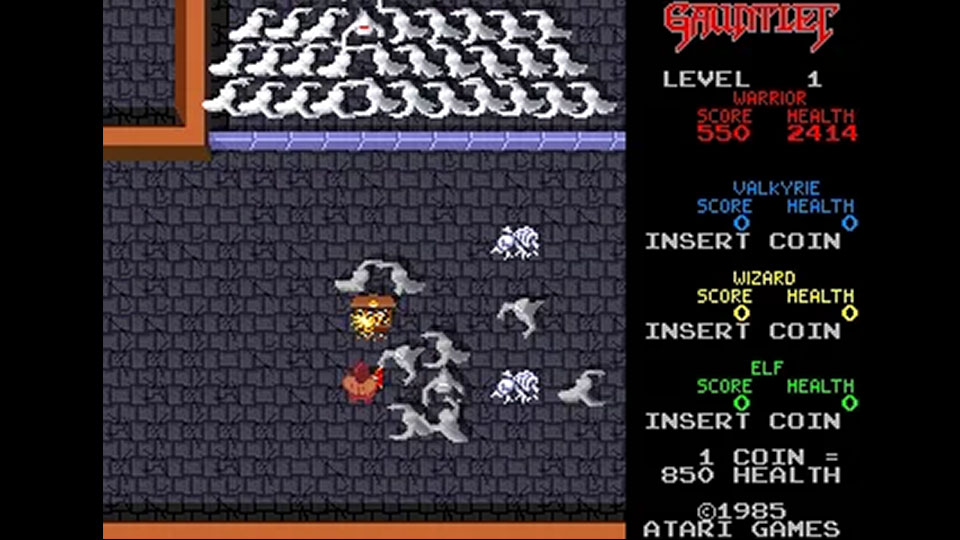
This classic old game is set within a series of top-down, 3rd-person mazes where the object is to kill monsters, gather treasures, and find the exit in every level. An assortment of special items can be located in each level. These items can increase the player’s health, unlock doors, award more points and destroy all of the enemies on screen.
Each player controls 1 of 4 playable fantasy-based characters: Thor, a warrior; Merlin, a wizard; Thyra, a valkyrie; or Questor, an Elf. The characters are named on the cabinet artwork, but in-game they are referred only by the title of their classes. Each character has his or her own unique strengths and weaknesses. For example, the warrior is strongest in hand-to-hand combat, the wizard has the most powerful magic, the valkyrie has the best armor, and the Elf is the fastest in movement. The characters are assigned by control panel in the 4-player version, whereas in the 2-player version each player selects their own character at the start of the game or while joining during the middle of play.
The enemies are an assortment of fantasy-based monsters, including ghosts, grunts, demons, lobbers, sorcerers, and thieves. Each enters the level through specific generators, which can be destroyed. The most dangerous enemy is Death, who can only be destroyed by using a magic potion—otherwise Death will vanish automatically after it has drained a certain amount of health from the player.
As the game progresses, higher levels of skill are needed to reach the exit, with success often depending on the willingness of the players to cooperate by sharing food and luring monsters into places where they can be engaged and slaughtered more conveniently. While contact with enemies reduces the player’s health, health also slowly drains on its own, thus creating a time limit. When a character’s health reaches zero, that character dies. The character can be revived in place with full health by spending a game credit—inserting a coin in the arcade—within a certain short time window after it died. This allows even the least proficient players to keep playing indefinitely, if they are willing to keep inserting coins. However, each player’s final score will be divided by the amount of credits they used to play.
Aside from the ability to have up to four players at once, the game is also noted for the narrator’s voice, which is produced by a TMS5220C speech chip. The TMS5220C speech was encoded by Earl Vickers. The narrator (voiced by Ernie Fosselius) frequently makes statements repeating the game’s rules, including: “Shots do not hurt other players, yet”, “Remember, don’t shoot food”, “Elf shot the food”, and “Warrior needs food, badly”. The narrator occasionally comments on the battle by saying, “I’ve not seen such bravery” or “Let’s see you get out of here”. When a player’s life force points fall below 200, the narrator states, “Your life force is running out”, “Elf needs food”, or “Valkyrie is about to die”.
The control panel for the 4-player cabinet is wider than other standard uprights in order to accommodate four people at the same time. Each player has an 8-way joystick and two buttons: one for “fire” (ranged attack) and one for “magic”. The “magic” button also starts the game. After Gauntlet‘s release, other games started using this design, so it was a popular conversion target for newer games after it had its run.
GAUNTLET Game Ports
Gauntlet was ported to MS-DOS, Apple II, Mac, MSX, Nintendo Entertainment System, Apple IIGS, Master System, Atari ST, Commodore 64, Atari 8-bit computers, Amstrad CPC, ZX Spectrum, and the original PlayStation console as part of Midway’s Arcade’s Greatest Hits: The Atari Collection 2. An X68000 version was under development by M2, before being showcased to Tengen and released as Gauntlet IV for Sega Genesis.
The NES version was developed and published by Tengen, Atari Games’ consumer software publishing division, and was released in 1988, and was the very first title to be developed in the United States for the NES.
Expansion pack
Gauntlet: The Deeper Dungeons is an expansion pack for the original computer ports of Gauntlet with 512 new levels. It was released in 1987 by the British company U.S. Gold in the UK and Europe, and Mindscape in the United States for the Amstrad CPC, MSX, Atari ST, Commodore 64, and ZX Spectrum ports of Gauntlet. It was developed by Gremlin Graphics.
Many of its levels were entries in a competition throughout Europe in which ten winners were awarded prizes, a Gauntlet T-shirt and a copy of the program for their computers. The contest was announced in the instructions of many of the ported games. The levels are presented randomly and its artwork is the side panel artwork of the arcade cabinet with only the main characters shown. The enemies were removed from the image and replaced with a pink background.
Reviewers noted that the levels were much harder than those in the original game, although the consensus was that it was not quite as good as the first game or the newly released arcade sequel.
GAUNTLET Reception
The game was highly profitable upon its November 1985 launch in North America, reportedly earning one San Mateo, California arcade operator $15,000 in sixteen weeks and another Canadian operator US$4,500 in nine days. In the United States, it topped the monthly RePlay upright arcade cabinet chart in December 1985, and topped the Play Meter arcade video game charts from January 1986 to March 1986; after being displaced by Sega‘s Hang-On in April, Gauntlet returned to the top spot in May. RePlay listed it as the second highest-grossing arcade video game of 1986 in the United States, below Hang-On, while AMOA listed it as the year’s highest-earning dedicated arcade cabinet. Atari ultimately sold a total of 7,848 Gauntlet video game arcade cabinets.
In Japan, Gauntlet was a commercial success for Namco. At a Japanese trade show in late 1985, the game drew large crowds and set record earnings for an Atari arcade cabinet. Game Machine listed Gauntlet on their March 15, 1986 issue as being the second most-popular upright/cockpit arcade game for the previous two weeks, below Sega’s Space Harrier, before Gauntlet topped the chart in April. It went on to be Japan’s third highest-grossing upright/cockpit arcade game during the first half of 1986 (below Hang-On and Space Harrier), and the sixth highest during the second half of the year. It was Japans’s fourth highest-grossing upright/cockpit arcade game of 1986 (below Hang-On, Space Harrier and Pole Position II).
In the United Kingdom, the home computer conversions topped the UK sales chart in December 1986. It went on to sell more than 200,000 copies in the UK by 1987, and over 300,000 copies as of 1988.
Critical
The arcade game received a positive review from Clare Edgeley of Computer and Video Games upon release. Yung Min Choi reviewed the home computer conversion of Gauntlet with Demon Stalkers for Computer Gaming World, and stated that “in reality, players who crave this type of action will not be disappointed with either game”.< Entertainment Weekly picked the game as the 14th-greatest game available in 1991, saying: “There have been sequels to this game, but nothing matches the original Gauntlet, an innovative, fast-playing mix of mazes, monsters, and magic spells”.
The Mac version was reviewed in 1989 in Dragon No. 150 by Hartley, Patricia, and Kirk Lesser in “The Role of Computers” column. The reviewers gave the game four out of five stars. Compute! praised the Macintosh version’s sound effects. Computer and Video Games praised the accuracy of the Amstrad version, and said that it had “great graphics, good sounds, and perfect playability”. Crash praised the smooth and fast scrolling, and the longevity, with Avenger being listed as the only alternative. In their Master System review, ACE said that people of all ages could quickly master the controls and tasks. The Spectrum version was the biggest-selling game of 1986, and was voted number 38 in the Your Sinclair Readers’ Top 100 Games of All Time.
More than a decade after release, the Official UK PlayStation Magazine noted that they “spent many a night hunched over a fag-stained Gauntlet machine”, but said that the limitations had become apparent in the late 1990s. Next Generation, while not including the game in their “Top 100 Games of All Time”, noted in the intro that “for the record, Gauntlet was number 101″. In 1995, Flux magazine rated the game 89th on their “Top 100 Video Games.” In 1996, GamesMaster ranked Gauntlet 18th in its “Top 100 Games of All Time.”
GAUNTLET Legacy
The arcade original was followed by a 1986 sequel, Gauntlet II, which was followed by further sequels on home platforms, including Gauntlet: The Third Encounter, Gauntlet III: The Final Quest, and Gauntlet IV. The arcade series was revived with Gauntlet Legends in 1998, which itself saw the sequels Gauntlet Dark Legacy and Gauntlet: Seven Sorrows. The original Gauntlet arcade game is included in Midway Arcade Treasures (2003) for the GameCube, PlayStation 2, Xbox, and Microsoft Windows, and Midway Arcade Origins (2012) for the Xbox 360 and PlayStation 3.
The game was rebooted in 2014 on home platforms as Gauntlet.
*Some of the content information above was provided by Wikipedia and KLOV (Killer List of Video Games).
*Visit our main website https://cocktailhourentertainment.com
For More Information fill out our Contact Form
WHY RENT YOUR FAVORITE CLASSIC ARCADE GAME FROM US?
If you’re planning an event in Florida we’re your one-stop-shop for “extra” entertainment.
PACKAGE DISCOUNTS
Rent 3 or more classic arcade games and get a special discount.
BIGGEST SELECTION
Florida’s largest selection of classic arcade games for rent.

COMPETITIVE PRICING
The best pricing in Florida for classic arcade game rentals.
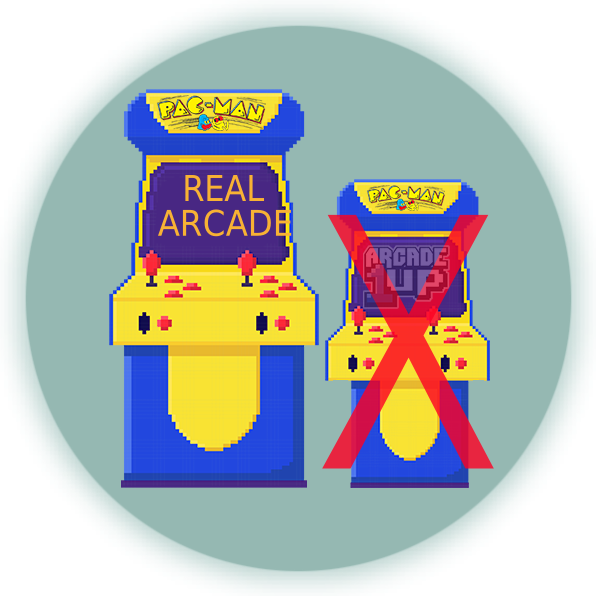
REAL ARCADE MACHINES
We rent real arcade machines, not Arcade1Up toys from walmart.
WE ARE A FLORIDA BASED RENTAL COMPANY
Always hire a local game rental company, not a game rental company located out of state! Why? The further a company has to travel the more likely something could go wrong. Most out of state game rental companies work from a rolodex. They put adds in every state and make a nice website creating the illusion they are local, but they’re based in another state such as New York or New Jersey. This is why their price is higher. Did you know they usually subcontract a local company like us because it’s easier and cheaper for them. We love being trusted to do this and we will only give out their business cards so you’d never know. Hire us directly for less!

Smart Recommendations
Trust the company hired by the Ritz Carlton, Four Season, The Breakers, Miami Heat, Orlando Magic, and so many others for their corporate events.
- Party Planners trust us for their game rental needs.
- Local and out of state DMCs trust us as a reliable source for game rentals.
- DJ companies, Bands, Caterers, Decorators, and even our competitors call us!
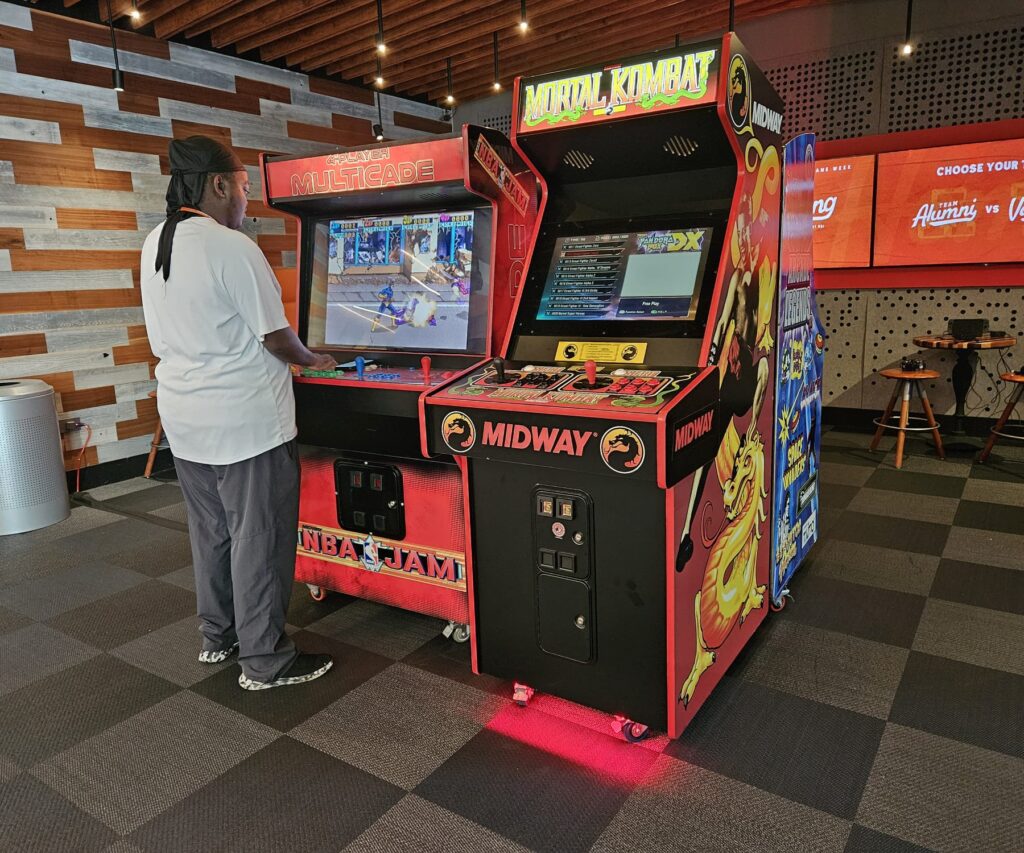

“Rent your Gauntlet classic arcade machine now!"
“Rent your Gauntlet classic arcade machine now!"
A few of our customers: