
JOUST ARCADE GAME RENTAL
Planning an event with arcade games?
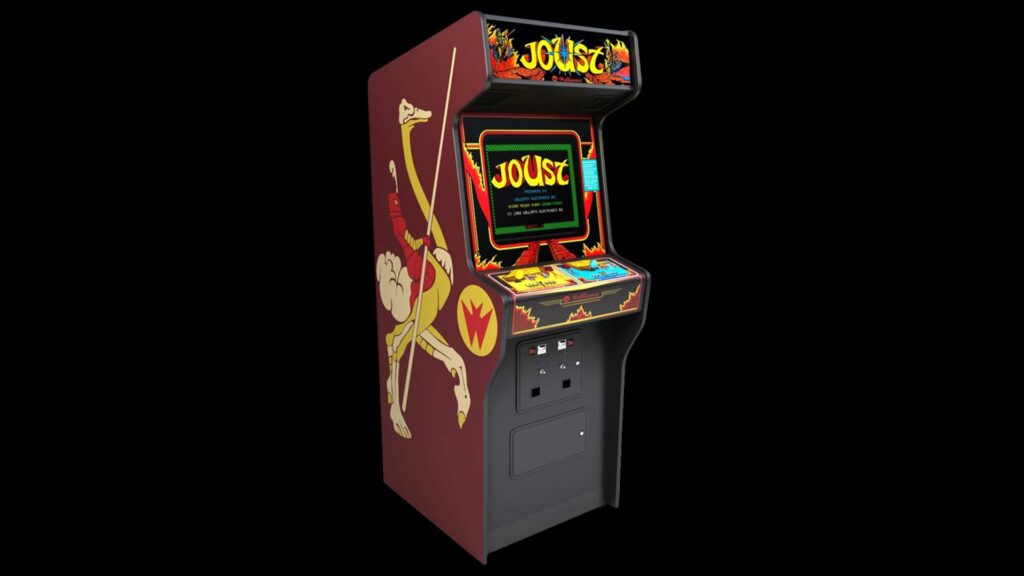
Here’s your chance to rent an old classic, a real Joust classic arcade machine game for your next party.
Whether it’s a birthday party, corporate event, or a tradeshow, you can rent your favorite retro arcade machine for your upcoming social function. Rent your favorite retro 1980’s (eighties) classic arcade game rental for your next event in Florida.
Joust is an old action game developed by Williams Electronics and released in arcades in 1982. While not the first two-player cooperative video game, Joust‘s success and polished implementation popularized the concept. Players assume the role of knights armed with lances and mounted on large birds (an ostrich for Player 1 and a stork for Player 2), who must defeat enemy knights riding buzzards. The characters fly around a single screen filled with floating platforms.
Using the computer hardware from the company’s earlier arcade game, John Newcomer led the development team: Bill Pfutzenreuter, Janice Woldenberg-Miller (née Hendricks), Python Anghelo, Tim Murphy, and John Kotlarik. Newcomer aimed to create a flying game, with cooperative two-player gameplay, while avoiding the overdone space theme. After deciding to use birds as characters, he forwent the standard eight-direction joystick control scheme and devised collisions as the means of combat.
The game was well-received by players and critics, and the mechanics influenced other games. It was followed by a more complex and less popular arcade sequel in 1986: Joust 2: Survival of the Fittest. Joust was ported to numerous home systems and included in several multiplatform retro game anthologies.
JOUST GAME PLAY
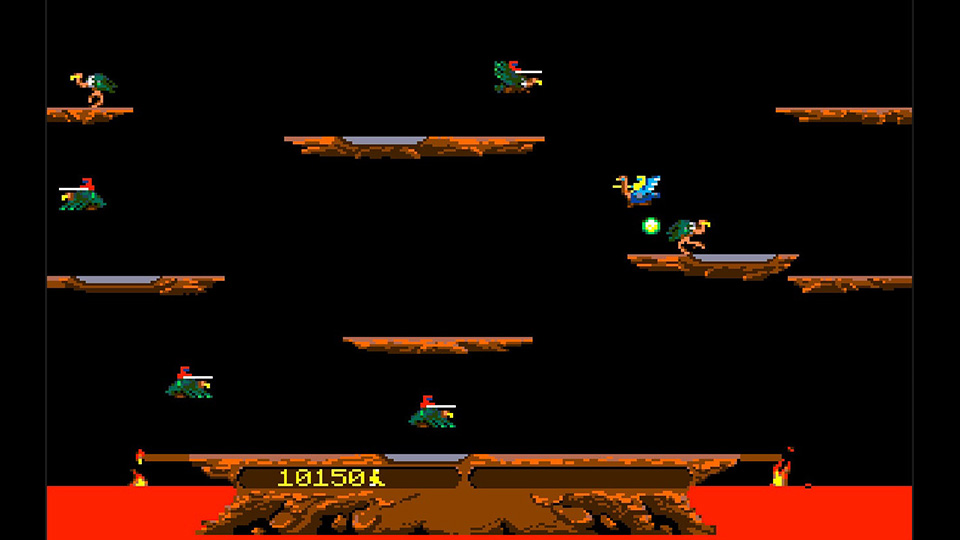
Joust is an old platforming game where the player controls a yellow knight riding a flying ostrich from a third-person perspective. The player navigates the protagonist around the game world, which consists of rock platforms floating above a flat island surrounded by lava, via two-way joystick and a button. Home console versions, however, use game controllers with directional pads and analog sticks. The joystick controls the horizontal direction that the knight travels, while pressing the button flaps the ostrich’s wings. The rate at which the player repeatedly presses the button directly determines the bird’s ascension, allowing the character to fly upward, hover, or slowly descend. When traveling off the screen to either side, the character will continue its path reappearing from the opposite side.
The objective is to defeat groups of enemy knights riding buzzards that populate each level, referred to as a “wave”. Upon completing a wave, a subsequent, more challenging one will begin. Players pilot the knight to collide with enemies. The higher of two jousting lances is the winner, whereas a collision of equal height repels the characters apart. A defeated enemy will turn into an egg that falls toward the bottom of the screen, which a player can collect for points. If the player does not collect the egg, it will hatch into a new knight that gains a new mount and must be defeated again. The game features three type of enemy knights—Bounder, Hunter, and Shadow Lord—that are separate colors and are worth different amounts of points. A pterodactyl will appear after a predetermined time frame to hunt the hero. Players can defeat the pterodactyl for bonus points. An indestructible Lava Troll will grab any character flying too low over the lava and drags them into the lava. Losing a clash against an opponent or contact with lava deducts an available game life; the game ends when all game lives are expended. A second player can join the game, controlling a blue knight on a stork. The two players cooperatively complete the waves, optionally attacking each other.
JOUST GAME RELEASE
Williams first released Joust into arcades in September 1982. A cocktail table version was later released, engineered by Leo Ludzia. It is unique among cocktail games with its side-by-side seating rather than opposing sides, which allowed Williams to reuse the same ROM chip from the upright cabinets. With substantially fewer units manufactured (between 250-500 units) than the upright arcade machine, the cocktail version is a rare collector’s item.
JOUST GAME PORTS
Soon after its arcade release, Atari, Inc. acquired the licensing rights to release home ports of Joust. The company published ports on its own systems (the Atari 2600 and Atari 5200 home consoles), and under its Atarisoft label, on the Apple II and personal computers. While Atari was brokering a deal with Nintendo in 1983 to distribute the soon-to-be released Famicom console and games outside Japan, Satoru Iwata from HAL Laboratory approached Nintendo about developing for its new console. After meeting with Nintendo, Iwata was assigned the task of converting Joust for the Famicom, a project he completed in two months. However, the deal between Atari and Nintendo collapsed, and the Famicom port was shelved until 1987, when HAL Laboratory was able to published it in Japan. A North American version for the Nintendo Entertainment System followed the next year.
A BBC Micro version was in development in 1984, programmed by Delos Harriman. However, it was unfinished when the Atarisoft label was discontinued.[Note 1] Aardvark Software picked up development and finished the game in 1985, but after the company appeared to disappear, the port remained unreleased until Harriman began selling it the next year. A new company, Go-Dax, later released a clone titled Skirmish in 1988 for the BBC Micro and Acorn Electron home computers Harriman was credited as the creator of Skirmish in Acorn User magazine’s coverage of other Go-Dax games. A port for the ColecoVision was also in production under the Atarisoft label; however, development ceased after a prototype was created. It was unavailable until CGE Services reproduced the prototype cartridges for release at the 2001 Classic Gaming Expo in Las Vegas.[22]
Williams Entertainment would later include Joust in several of its multiplatform arcade compilations over a decade after its initial release: the 1995 Williams Arcade’s Greatest Hits, the 2000 Midway’s Greatest Arcade Hits, the 2003 Midway Arcade Treasures, and the 2012 Midway Arcade Origins. Additional compilations are the 1995 Arcade Classic 4 for the Game Boy, the 2005 Midway Arcade Treasures: Extended Play for the PlayStation Portable, and the 2022 Midway Legacy Edition Arcade1Up cabinet. Many of the anthologies were created by Digital Eclipse, who used emulation to run the original source code. The company included Joust because of its high recognizability. In 2000, a web-based version of Joust, along with nine other classic arcade games, was published on Shockwave.com. Four years later, Midway Games launched a website featuring the Shockwave versions. A mobile phone version was released in 2005, but omitted the flapping control scheme. Joust was released via digital distribution in 2007 on GameTap, Xbox Live Arcade, and the PlayStation Network. Joust, along with many other Midway arcade games, appear in an expansion of Lego Dimensions. The developer, Traveller’s Tales, considered recreating them in Lego form but decided to present them in their original forms to maintain what they felt made the games good. Lego versions of Joust characters appear outside the emulated games in the expansion’s virtual Lego world.
JOUST RETROSPECTIVE
In 1995, Flux magazine ranked the arcade version 26th on their “Top 100 Video Games” list. In 1996, Next Generation listed the arcade version as number 83 on its “Top 100 Games of All Time”, saying that it had original concepts, quirky designs, and playability. Video game historian Steve Kent considered Joust one of the more memorable games of its time. Author David Ellis agreed, writing that the game remains enjoyable even in modern times. In 2008, Guinness World Records listed it as the number sixty-nine arcade game in terms of technical, creative, and cultural impact. In 2015, Hardcore Gamer listed the game on their “200 Best Video Games of All Time”.
*Some of the content information above was provided by Wikipedia and KLOV (Killer List of Video Games).
*Visit our main website https://cocktailhourentertainment.com
For More Information fill out our Contact Form
WHY RENT YOUR FAVORITE CLASSIC ARCADE GAME FROM US?
If you’re planning an event in Florida we’re your one-stop-shop for “extra” entertainment.
PACKAGE DISCOUNTS
Rent 3 or more classic arcade games and get a special discount.
BIGGEST SELECTION
Florida’s largest selection of classic arcade games for rent.
COMPETITIVE PRICING
The best pricing in Florida for classic arcade game rentals.
REAL ARCADE MACHINES
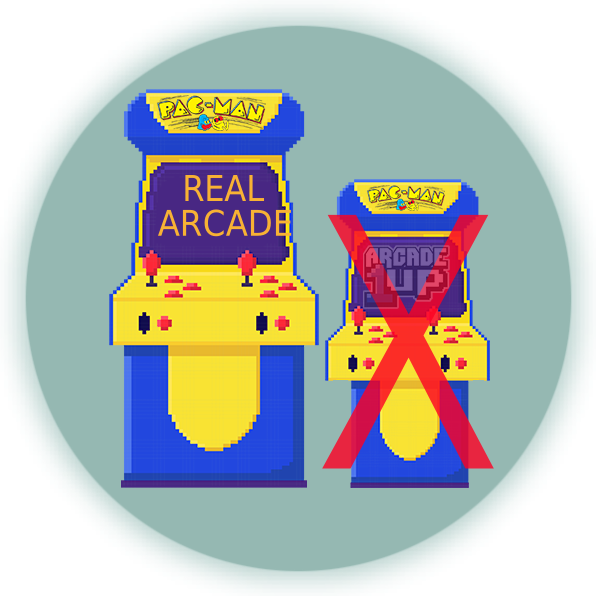
We rent real arcade machines, not Arcade1Up toys from walmart.
WE ARE A FLORIDA BASED RENTAL COMPANY
Always hire a local game rental company, not a game rental company located out of state! Why? The further a company has to travel the more likely something could go wrong. Most out of state game rental companies work from a rolodex. They put adds in every state and make a nice website creating the illusion they are local, but they’re based in another state such as New York or New Jersey. This is why their price is higher. Did you know they usually subcontract a local company like us because it’s easier and cheaper for them. We love being trusted to do this and we will only give out their business cards so you’d never know. Hire us directly for less!

Smart Recommendations
Trust the company hired by the Ritz Carlton, Four Season, The Breakers, Miami Heat, Orlando Magic, and so many others for their corporate events.
- Party Planners trust us for their game rental needs.
- Local and out of state DMCs trust us as a reliable source for game rentals.
- DJ companies, Bands, Caterers, Decorators, and even our competitors call us!
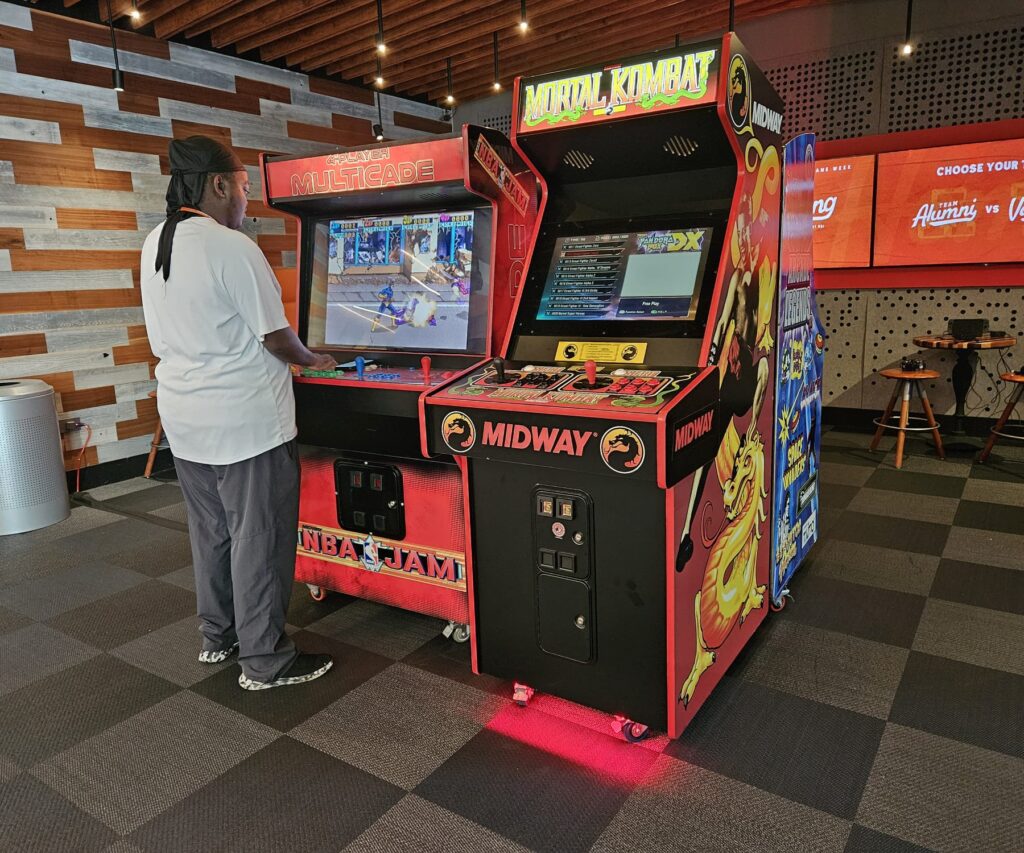

“Rent your JOUST classic arcade machine now!"
“Rent your JOUST classic arcade machine now!"
A few of our customers: