
PAC-MAN ARCADE GAME RENTAL
Planning an event with arcade games?
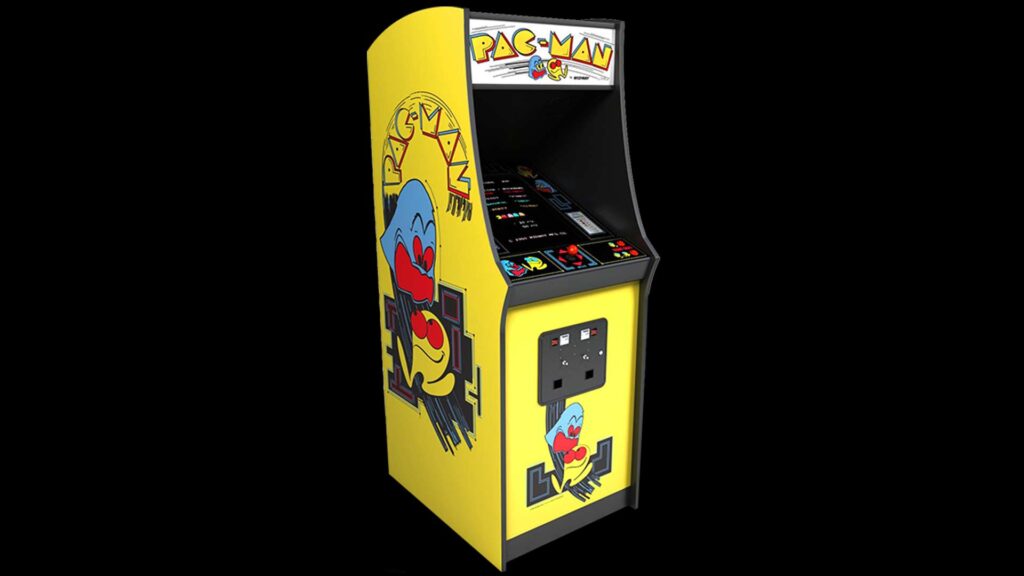
Here’s your chance to rent an old classic, a real pacman (Pac-Man) arcade machine game for your next party or event in Florida.
Whether it’s a birthday party, corporate event, or a tradeshow, you can rent your favorite retro arcade machine for your upcoming social function. Rent your favorite retro 1980’s (eighties) classic arcade game rental for your next event in Florida.
Pacman will be referred to as Pac-Man for the rest of this article since it is the correct spelling, originally called Puck Man in Japan, is a 1980 maze video game developed and published by Namco for arcades. The name was changed to pac-man because puckman rhymes with a curse word!
In North America, the game was released by Midway Manufacturing as part of its licensing agreement with Namco America. The player controls Pac-Man, who must eat all the dots inside an enclosed maze while avoiding four colored ghosts.
Eating large flashing dots called “Power Pellets” causes the ghosts to temporarily turn blue, allowing Pac-Man to also eat the ghosts for bonus points.
Although the inspiration for the Pac-Man character was the image of a pizza with a slice removed, Iwatani has said he rounded out the Japanese character for mouth, kuchi (Japanese: 口). The in-game characters were made to be cute and colorful to appeal to younger players.
The original Japanese title of Puck Man was derived from the Japanese phrase paku paku taberu, which refers to gobbling something up; the title was changed to Pac-Man for the North American release due to fears of vandals turning the P into an F to make it a curse word.
PACMAN [Pac-Man] GAME PLAY
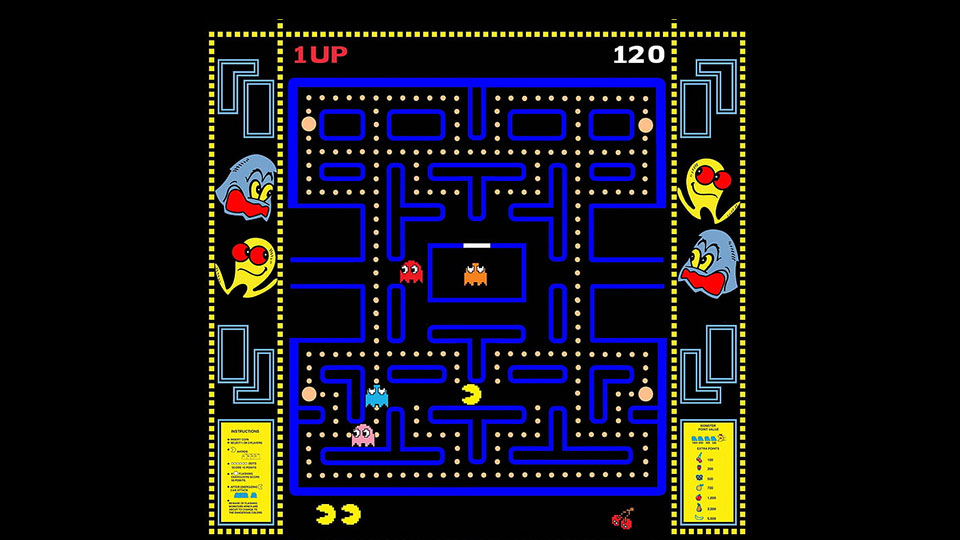
Pac-Man is an action maze chase arcade video game; the player controls pie shaped main character through an enclosed maze.
The objective of the game is to eat all of the dots in the maze while avoiding four colored ghosts—Blinky (red), Pinky (pink), Inky (cyan), and Clyde (orange)—who pursue Pac-Man.
When Pac-Man eats all of the dots, the player advances to the next level. Levels are indicated by fruit icons at the bottom of the screen.
In between levels are short cutscenes featuring Pac-Man and Blinky in humorous, comical skits.
If Pac-Man is caught by a ghost, he loses a life; the game ends when all lives are lost.
Each of the four ghosts has its own unique artificial intelligence (A.I.), or “personality”: Blinky gives direct chase to Pac-Man; Pinky and Inky try to position themselves in front of Pac-Man, usually by cornering him; and Clyde switches between chasing Pac-Man and fleeing from him.
Placed near the four corners of the maze are large flashing “energizers” or “power pellets”. When Pac-Man eats one, the ghosts turn blue with a dizzied expression and reverse direction. Pac-Man can eat blue ghosts for bonus points; when a ghost is eaten, its eyes make their way back to the center box in the maze, where the ghost “regenerates” and resumes its normal activity.
Eating multiple blue ghosts in succession increases their point value. After a certain amount of time, blue-colored ghosts flash white before turning back into their normal forms.
Eating a certain number of dots in a level causes a bonus item—usually a fruit—to appear underneath the center box; the item can be eaten for bonus points.
To the sides of the maze are two “warp tunnels”, which allow Pac-Man and the ghosts to travel to the opposite side of the screen. Ghosts become slower when entering and exiting these tunnels.
The game increases in difficulty as the player progresses: the ghosts become faster, and the energizers’ effect decreases in duration, eventually disappearing entirely.
An integer overflow causes the 256th level to load improperly, rendering it impossible to complete. This is known as a kill screen.
PACMAN [Pac-Man] Game Release
Location testing for Puck Man began on May 22, 1980, in Shibuya, Tokyo. Non-gamers responded well to it, finding it easy to learn, while arcade regulars were not impressed. A private showing for the game was done in June, followed by a nationwide release in July.
Eyeing the game’s success in Japan, Namco initialized plans to bring the game to the international market, particularly the United States. Before showing the game to distributors, Namco America made a number of changes, such as altering the names of the ghosts.
Another was the game’s title, as executives at Namco were worried that vandals would change the “P” in Puck Man to an “F”.
Masaya Nakamura chose to rename it to Pac-Man, as he felt it was closer to the game’s original Japanese title of Pakkuman. In Europe, the game was released under both titles. After Puck Man was ruled out but before Pac-Man was decided upon, early American promotional material used the name Snapper.
When Namco presented Pac-Man and Rally-X to potential distributors at the 1980 AMOA tradeshow in November, executives believed that Rally-X would be the best-selling game of that year.
According to Play Meter magazine, both Pac-Man and Rally-X received mild attention at the show. Namco had initially approached Atari to distribute Pac-Man, but Atari refused the offer.
Midway Manufacturing subsequently agreed to distribute both Pac-Man and Rally-X in North America, announcing their acquisition of the manufacturing rights on November 22 and releasing them in December.
Pacman [Pac-Man] Game Ports
Pac-Man was ported to several home video game systems and personal computers; the most infamous of these is the 1982 Atari 2600 conversion, designed by Tod Frye and published by Atari, Inc.This version of the game was widely criticized for its inaccurate portrayal of the arcade version and for its peculiar design choices, most notably the flickering effect of the ghosts. However, it was a commercial success, selling over seven million copies.
Atari released versions for the Intellivision, VIC-20, Commodore 64, Apple II, IBM PC compatibles, TI-99/4A, ZX Spectrum, and the Atari 8-bit computers. A port for the Atari 5200 was released in 1983, a version that is considered as a significant improvement over the Atari 2600 version.
Namco released a version for the Nintendo Famicom in 1984 as one of the console’s first third-party titles,[46] as well as a port for the MSX computer.
The Famicom version was later released in North America for the Nintendo Entertainment System by Tengen, a subsidiary of Atari Games.
Tengen produced an unlicensed version of the game in a black cartridge shell, released during a time when Tengen and Nintendo were in disagreements over the latter’s stance on quality control for its consoles; this version was re-released by Namco as an official title in 1993, featuring a new cartridge label and box.
The Famicom version was released for the Famicom Disk System in 1990 as a budget title for the Disk Writer kiosks in retail stores. The same year, Namco released a port of Pac-Man for the Game Boy, which allowed for two-player co-operative play via the Game Link Cable peripheral. A version for the Game Gear was released a year later, which likewise enabled support for multiplayer.
In celebration of the game’s 20th anniversary in 1999, Namco re-released the Game Boy version for the Game Boy Color, bundled with Pac-Attack and titled Pac-Man: Special Color Edition. The same year, Namco and SNK co-published a port for the Neo Geo Pocket Color, which came with a circular “Cross Ring” that attached to the d-pad to restrict it to four-directional movement.
In 2001, Namco released a port of Pac-Man for various Japanese mobile phones, being one of the company’s first mobile game releases. The Famicom version of the game was re-released for the Game Boy Advance in 2004 as part of the Famicom Mini series, released to commemorate the 25th anniversary of the Famicom; this version was released in North America and Europe under the Classic NES Series label. Namco Networks released Pac-Man for BREW mobile devices in 2005. The arcade original was released for the Xbox Live Arcade service in 2006, featuring achievements and online leaderboards.
In 2009 a version for iOS devices was published; this release was rebranded as Pac-Man + Tournaments in 2013, featuring new mazes and leaderboards. The NES version was released for the Wii Virtual Console in 2007. A Roku version was released in 2011, alongside a port of the Game Boy release for the 3DS Virtual Console.
Pac-Man was one of four titles released under the Arcade Game Series brand, which was published for the Xbox One, PlayStation 4 and PC in 2016.
In 2021, according to Nintendo Direct, it was announced that Hamster Corporation would release Pac-Man, along with Xevious, for the Nintendo Switch and PlayStation 4 as part of its Arcade Archives series, marking the first two Namco games to be included as part of the series.
Pac-Man is included in many Namco compilations, including Namco Museum Vol. 1 (1995), Namco Museum 64 (1999), Namco Museum Battle Collection (2005),[57] Namco Museum DS (2007), Namco Museum Essentials (2009),[58] and Namco Museum Megamix (2010).
In 1996, it was re-released for arcades as part of Namco Classic Collection Vol. 2, alongside Dig Dug, Rally-X and special “Arrangement” remakes of all three titles. Microsoft included Pac-Man in Microsoft Return of Arcade (1995) as a way to help attract video game companies to its Windows 95 operating system. Namco released the game in the third volume of Namco History in Japan in 1998.
The 2001 Game Boy Advance compilation Pac-Man Collection compiles Pac-Man, Pac-Mania, Pac-Attack and Pac-Man Arrangement onto one cartridge. Pac-Man is a hidden extra in the arcade game Ms. Pac-Man/Galaga – Class of 1981 (2001).
A similar cabinet was released in 2005 that featured Pac-Man as the centerpiece. Pac-Man 2: The New Adventures (1993) and Pac-Man World 2 (2002) have Pac-Man as an unlockable extra. Alongside the Xbox 360 remake Pac-Man Championship Edition, it was ported to the Nintendo 3DS in 2012 as part of Pac-Man & Galaga Dimensions. The 2010 Wii game Pac-Man Party and its 2011 3DS remake include Pac-Man as a bonus game, alongside the arcade versions of Dig Dug and Galaga.
In 2014, Pac-Man was included in the compilation title Pac-Man Museum for the Xbox 360, PlayStation 3 and PC, alongside several other Pac-Man games.[71] The NES version is one of 30 games included in the NES Classic Edition.
*Some of the content information above was provided by Wikipedia and KLOV (Killer List of Video Games).
*Visit our main website https://cocktailhourentertainment.com
For More Information fill out our Contact Form
WHY RENT YOUR FAVORITE CLASSIC ARCADE GAME FROM US?
If you’re planning an event in Florida we’re your one-stop-shop for “extra” entertainment.
PACKAGE DISCOUNTS
Rent 3 or more classic arcade games and get a special discount.
BIGGEST SELECTION
Florida’s largest selection of classic arcade games for rent.
COMPETITIVE PRICING
The best pricing in Florida for classic arcade game rentals.
REAL ARCADE MACHINES
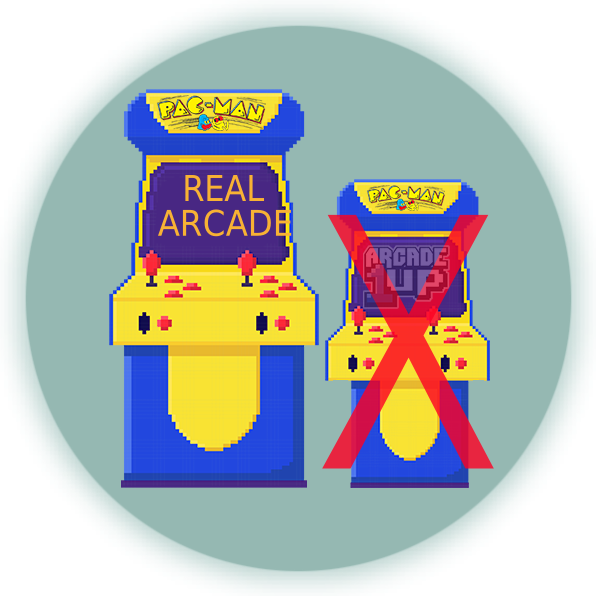
We rent real arcade machines, not Arcade1Up toys from walmart.
WE ARE A FLORIDA BASED RENTAL COMPANY
Always hire a local game rental company, not a game rental company located out of state! Why? The further a company has to travel the more likely something could go wrong. Most out of state game rental companies work from a rolodex. They put adds in every state and make a nice website creating the illusion they are local, but they’re based in another state such as New York or New Jersey. This is why their price is higher. Did you know they usually subcontract a local company like us because it’s easier and cheaper for them. We love being trusted to do this and we will only give out their business cards so you’d never know. Hire us directly for less!

Smart Recommendations
Trust the company hired by the Ritz Carlton, Four Season, The Breakers, Miami Heat, Orlando Magic, and so many others for their corporate events.
- Party Planners trust us for their game rental needs.
- Local and out of state DMCs trust us as a reliable source for game rentals.
- DJ companies, Bands, Caterers, Decorators, and even our competitors call us!
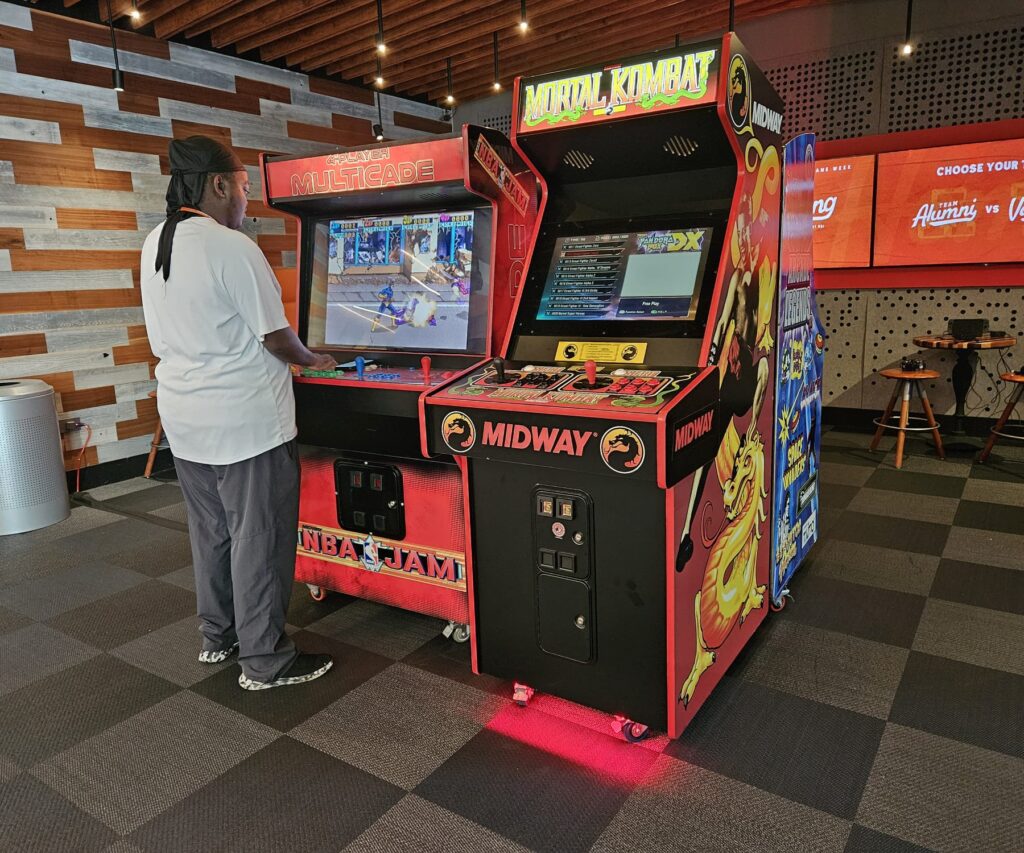

“Rent your Pac-man classic arcade machine now!"
“Rent your Pac-man classic arcade machine now!"
A few of our customers: