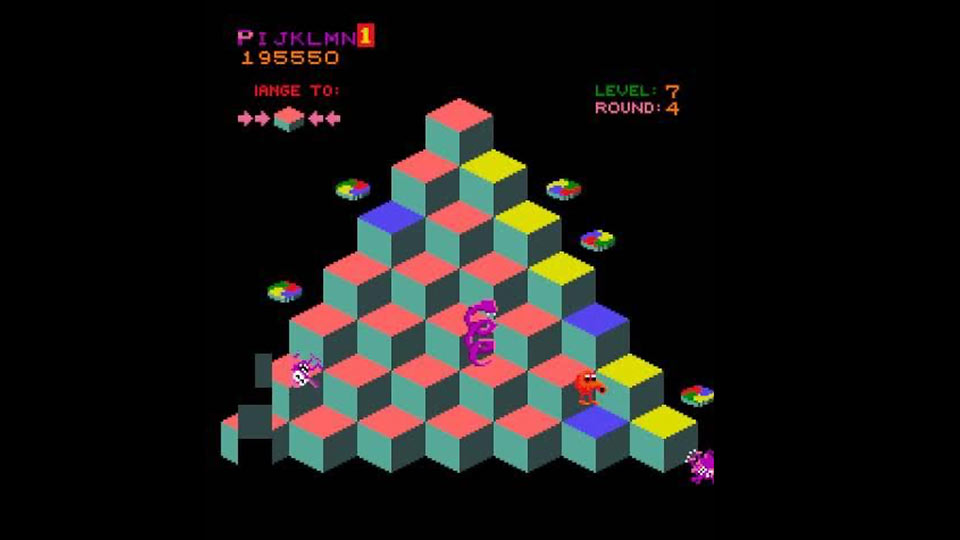
QBERT [Q*BERT] GAME PLAY
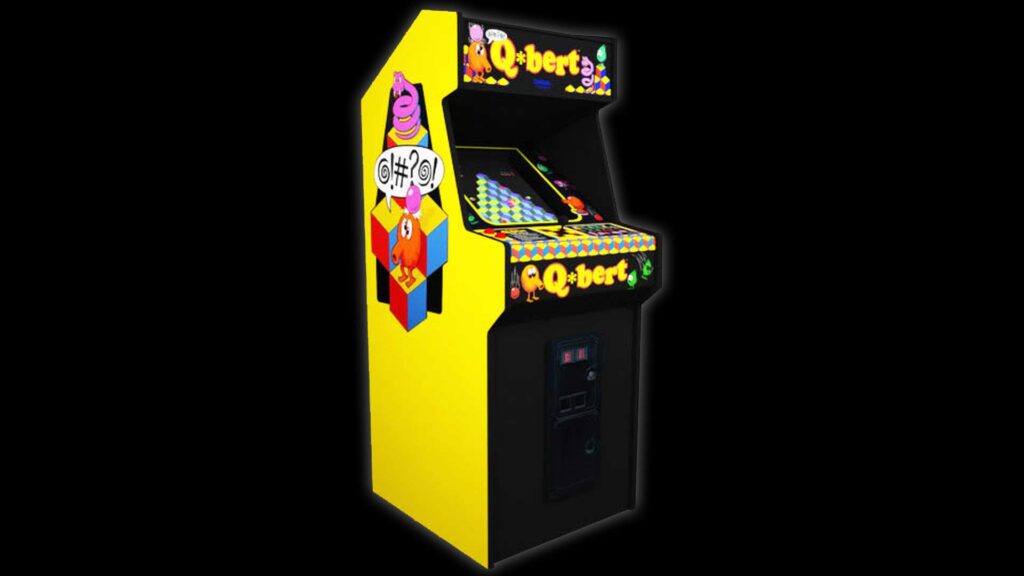
Q*bert is an action game with puzzle elements played from an axonometric third-person perspective to convey a three-dimensional look. The game is played using a single, diagonally mounted four-way joystick. The player controls Q*bert, who starts each game at the top of a pyramid made of 28 cubes, and moves by hopping diagonally from cube to cube. Landing on a cube causes it to change color, and changing every cube to the target color allows the player to progress to the next stage.
At the beginning, jumping on every cube once is enough to advance. In later stages, each cube must be hit twice to reach the target color. Other times, cubes change color every time Q*bert lands on them, instead of remaining on the target color once they reach it. Both elements are then combined in subsequent stages. Jumping off the pyramid results in the character’s death.

The player is impeded by several enemies, introduced gradually to the game:
- Coily – Coily first appears as a purple egg that bounces to the bottom of the pyramid and then transforms into a snake that chases Q*bert. He is often considered the main antagonist and Q*bert’s arch-nemesis. Q*bert will die if he collides with Coily.
- Ugg and Wrongway – Two purple creatures that hop along the sides of the cubes in an Escheresque manner. Starting at either the bottom left or bottom right corner, they keep moving toward the top right or top left side of the pyramid respectively and fall off the pyramid when they reach the end. Both are dangerous. Q*bert will also die if he collides with them.
- Slick and Sam – Two green creatures that descend down the pyramid and revert cubes whose color has already been changed. They do not hurt Q*bert, but are annoying, as they change the color of the cube to the original or former color, making the pyramid of cubes harder to solve for Q*bert.
Contact with purple enemies results in a life lost, whereas the green ones are removed from the board upon contact. Colored balls occasionally appear at the second row of cubes and bounce downward; contact with a red ball also results in a life lost, while contact with a green one immobilizes the on-screen enemies for a limited time. Multicolored floating discs on either side of the pyramid serve as an escape from danger, particularly Coily. When Q*bert jumps on a disc, it transports him to the top of the pyramid. If Coily is in close pursuit of the character, he will jump after Q*bert and fall to his death, awarding bonus points. This causes all enemies and balls on the screen to disappear, though they start to return after a few seconds.
Points are awarded for each color change (15 or 25), defeating Coily with a flying disc (500), remaining discs at the end of a stage (at higher stages, 50 or 100) and catching green balls (100) or Slick and Sam (300 each). Bonus points are also awarded for completing a screen, starting at 1,000 points on the first screen of Level 1 and increasing by 250 on each subsequent completion, up to 5,000 after Level 4. Extra lives are granted for reaching certain scores, which are set by the machine operator.
Title
The Gottlieb staff had difficulty naming the game. Aside from the project name “Cubes“, it was untitled for most of the development process. The staff agreed the game should be named after the main character, but disagreed on the name. Lee’s title for the initial concept—Snots And Boogers—was rejected, as was a list of suggestions compiled from company employees. According to Davis, vice president of marketing Howie Rubin championed @!#?@! as the title. Although staff members argued it was silly and would be impossible to pronounce, a few early test models were produced with @!#?@! as the title on the units’ artwork. During a meeting, “Hubert” was suggested, and a staff member thought of combining “Cubes” and “Hubert” into “Cubert”. Art director Richard Tracy changed the name to “Q-bert”, and the hyphen was later changed to an asterisk. In retrospect, Davis expressed regret for the asterisk, because it prevented the name from becoming a common crossword term and it is a wildcard character for search engines.
Release
Q*bert is Gottlieb’s fourth video game. A copyright claim registered with the United States Copyright Office by Gottlieb on February 10, 1983 cites the date of publication of Q*bert as October 18, 1982.
Video Games reported that the game was sold directly to arcade operators at its public showing at the AMOA show held November 18–20, 1982. Gottlieb offered the machines for $2600 per unit.
Cash Box magazine listed the mass-market US release date as December 1982. The game was distributed in Japan by Konami and Sega in March 1983. It was also released in Europe in March 1983.
Reception
Q*bert is Gottlieb’s only video game that earned considerable critical and commercial success, selling around 25,000 arcade cabinets. In the United States, it was among the thirteen highest-grossing arcade games of 1983. Cabaret and cocktail versions of the game were later produced. The machines have since become collector’s items; the rarest of them are the cocktail versions.
When the game was first introduced to a wider industry audience at the November 1982 AMOA show, it was immediately received favorably by the press. Video Games magazine placed Q*bert first in its list of Top Ten Hits, describing it as “the most unusual and exciting game of the show” and stating that “no operator dared to walk away without buying at least one”. The Coin Slot reported “Gottlieb’s game, Q*BERT, was one of the stars of the show”, and predicted that “The game should do very well”.
Contemporaneous reviews were equally enthusiastic, and focused on the uniqueness of the gameplay and audiovisual presentation. Roger C. Sharpe of Electronic Games considered it “a potential Arcade Award winner for coin-op game of the year”, praising innovative gameplay and outstanding graphics. William Brohaugh of Creative Computing Video & Arcade Games described the game as an “all-round winner” that had many strong points. He praised the variety of sound effects and the graphics, calling the colors vibrant. Brohaugh lauded Q*bert‘s inventiveness and appeal, stating that the objective was interesting and unique. Michael Blanchet of Electronic Fun suggested the game might push Pac-Man out of the spotlight in 1983. Neil Tesser of Video Games also likened Q*bert to games released in the early 1980s in Japan, like Pac-Man and Donkey Kong, due to the focus on characters, animation and story lines, as well as the “absence of violence”. Computer and Video Games magazine praised the game’s graphics and colors.
Electronic Games awarded Q*bert “Most Innovative Coin-op Game” of the year. Video Games Player called it the “Funniest Game of the Year” among arcade games in 1983.
Q*bert continues to be recognized as a significant part of video game history. Author Steven Kent and GameSpy‘s William Cassidy considered Q*bert one of the more memorable games of its time. Author David Ellis echoed similar statements, calling it a “classic favorite”. 1UP.com‘s Jeremy Parish and Kim Wild of Retro Gamer magazine described the game as difficult yet addictive. Author John Sellers also called Q*bert addictive, and praised the sound effects and three-dimensional appearance of the graphics. Cassidy called the game unique and challenging; he attributed the challenge in part to the control scheme. IGN‘s Jeremy Dunham believed the controls were poorly designed, describing them as “unresponsive” and “a struggle”. He nonetheless considered the game addictive.
Edge magazine attributed the success of the game to the title character. They stated that players could easily relate to Q*bert, particularly because he swore. Computer and Video Games, however, considered the swearing a negative but the character appealing. Cassidy believed the game’s appeal lay in the main character. He described Q*bert as cute and having a personality that made him stand out in comparison to other popular video game characters. The authors of High Score! referred to Q*bert as “ultra-endearing alien hopmeister”, and the cutest game character of 1982.
Ports

At the 1982 AMOA Show, Parker Brothers secured the license to publish home conversions of the Q*bert arcade game. Parker Brothers first published a port to the Atari 2600, and by the end of 1983, the company also advertised versions for Atari 5200, Intellivision, ColecoVision, Atari 8-bit computers, VIC-20, TI-99/4A, and Commodore 64. The release of the Commodore 64 version was noted to lag behind the others but appeared in 1984. Parker Brothers also translated the game into a standalone tabletop electronic game. It uses a VFD screen and has since become a rare collector’s item. Q*bert was also published by Parker Brothers for the Philips Videopac in Europe, by Tsukuda Original for the Othello Multivision in Japan, and by Ultra Games for the NES in North America.
The initial home port for the Atari 2600, the most widespread system at the time, was met with mixed reactions. Video Games warned that buyers of the Atari 2600 version “may find themselves just a little disappointed.” They criticized the lack of music, the removal of the characters Ugg and Wrongway, and the system’s troubles handling the character sprites at a steady performance. Later, Mark Brownstein of the same magazine was more in favor of the game, but still cited the presence of fewer cubes in the game’s pyramidal layout and “pretty poor control” as negatives. Will Richardson of Electronic Games noted a lack in audiovisual qualities and counter-intuitive controls, but commended the gameplay, stating that the game “comes much closer to its source of inspiration than a surface evaluation indicates.” Randi Hacker of Electronic Fun with Computers & Games called it a “sterling adaption [sic]” Computer and Video Games scored the Atari VCS version 70% in 1989 In 2008, IGN‘s Levi Buchanan rated it the fourth-worst arcade port for the Atari 2600, mostly because of a lack of jumping animations for enemies, which instead appear instantly on the adjacent cube, making it impossible to know in which direction they are traveling before they land. Entertainment Weekly called Q*Bert one of the top ten games for the Atari 2600 in 2013, saying the port “lost the cool isometric perspective but none of the addictive gameplay.”
Other home versions were well-received, with some exceptions. Of the ColecoVision version, Electronic Fun with Computers & Games noted that “Q*bert aficionados will not be disappointed.” Brownstein called it one of the best of the authorized versions. Warren Davis also considered the ColecoVision version the most accurate port of the arcade. Computer and Video Games gave the ColecoVision version a 72% score. Brownstein judged the Atari 5200 version inferior to that for the ColecoVision because of the imprecision of the Atari 5200 controller, but noted that “it does tend to grow on you.” Video Games identified the Intellivision version as the worst of the available ports, criticizing the system’s controller as inadequate for the game. Antic magazine’s David Duberman called the Atari 8-bit version “one of the finest translations of an arcade game for the home computer format”, and Arthur Leyenberger of Creative Computing listed it as a runner-up for Best Arcade Adaptation to the system, praising its faithful graphics, sound, movement and playability. Softline was more critical, criticizing the Atari version’s controls and lack of swearing. The magazine concluded that “the home computer game doesn’t have the sense of style of the one in the arcades … the execution just isn’t there.” In 1984, the magazine’s readers named the game the fifth-worst Atari program of 1983. Computer Games called the C64 version an “absolutely terrific translation” that “almost totally duplicates the arcade game,” aside from its lack of synthesized speech. The standalone tabletop was awarded Stand-Alone Game of the Year in Electronic Games. Electronic Gaming Monthly reviewed the NES version in 1989, with four critics scoring it 7, 3, 4 and 4 out of 10.
In 2003, a version for Java-based mobile phones was announced by Sony Pictures Mobile. Reviewers generally acknowledged it as a faithful port of the arcade original, but criticized the controls. Modojo‘s Robert Falcon stated that the diagonal controls take time to adapt to on a cell phone with traditional directions. Michael French of Pocket Gamer concluded: “You can’t escape the fact it doesn’t exactly fit on mobile. The graphics certainly do, and the spruced-up sound effects are timeless … but really, it’s a little too perfect a conversion.” Airgamer criticized the gameplay as monotonous and the difficulty as frustrating. By contrast, Wireless Gaming Review called it “one of the best of mobile’s retro roundup.”
On February 22, 2007, Q*bert was released on the PlayStation 3‘s PlayStation Network by fellow Sony subsidiary Sony Online Entertainment. It features upscaled and filtered graphics, an online leaderboard for players to post high scores, and Sixaxis motion controls. The game received a mixed reception. IGN‘s Jeremy Dunham and GameSpot‘s Jeff Gerstmann did not enjoy the motion controls and said that the game was a title only for nostalgic players. Eurogamer.net’s Richard Leadbetter judged the game’s elements “too simplistic and repetitive to make them worthwhile in 2007.” In contrast, 1UP.com’s Jeremy Parish considered the title worth purchasing, citing its addictive gameplay.
Legacy
According to Jeremy Parish, Q*bert is “one of the higher-profile titles of the classic era”. In describing Q*bert‘s legacy, Jeff Gerstmann of GameSpot referred to the game as a “rare arcade success”. In 2008, Guinness World Records ranked it behind 16 other arcade games in terms of their technical, creative and cultural impact. Though successful, the creators of the game did not receive royalties, as Gottlieb had no such program in place at the time. Davis and Lee nonetheless expressed pride about the game continuing to be remembered fondly.
MARKET IMPACT
Q*bert became one of the most merchandised arcade games behind Pac-Man, although according to John Sellers it was not nearly as successful as that franchise or Donkey Kong. The character’s likeness appears on various items including coloring books, sleeping bags, frisbees, board games, wind-up toys, and stuffed animals. In a flyer distributed in 1983, Gottlieb claimed over 125 licensed products. However, the video game crash of 1983 depressed the market, and the game’s popularity began to decline by 1984.
*Some of the content information above was provided by Wikipedia and KLOV (Killer List of Video Games).
*Visit our main website https://cocktailhourentertainment.com
For More Information fill out our Contact Form